Zoolbia and Bamieh
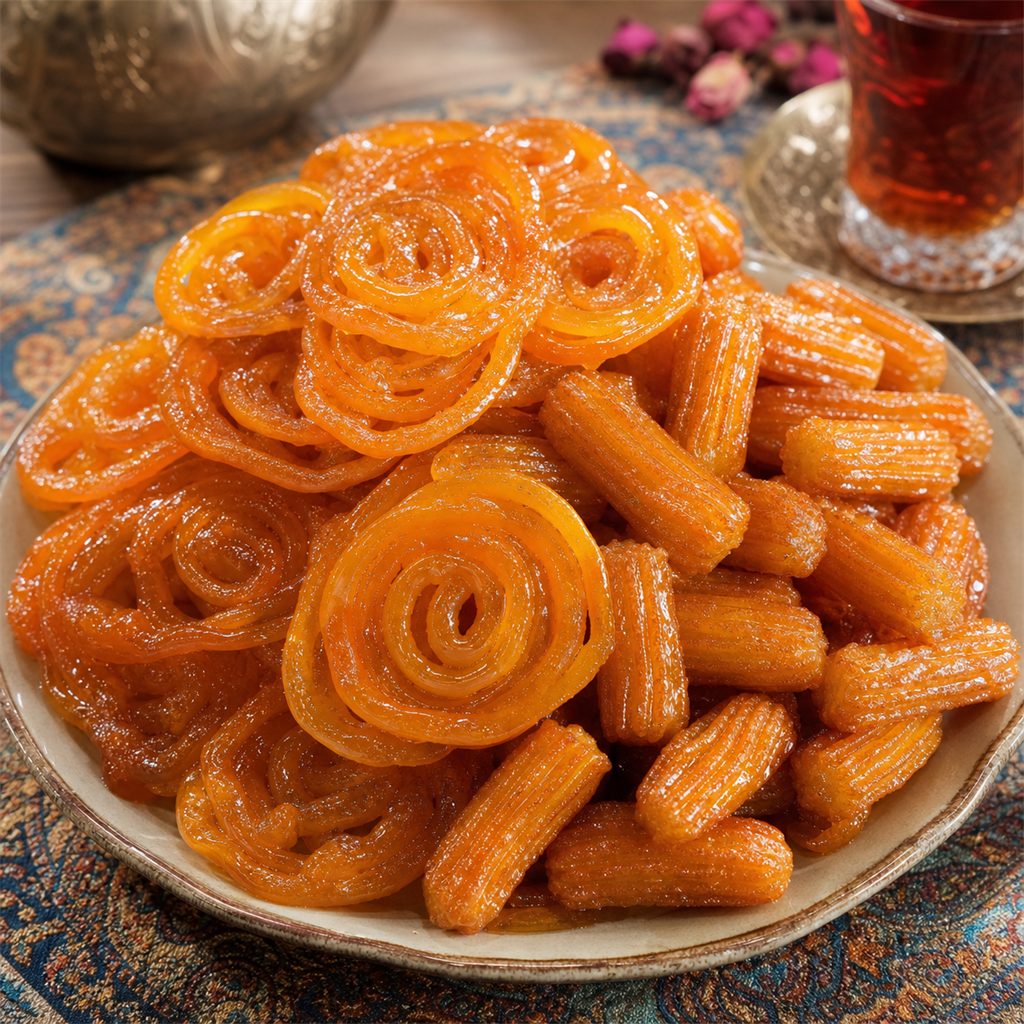
Two Iranian fried sweets—lacy zoolbia and ridged bamieh—dipped in saffron and rose syrup.
Preparation: 35 min · Cooking: 45 min · Total: 2 hr 10 min · 6 servings
Ingredients
- 120 g plain whole-milk yogurt
- 150 g plain flour — 25 g for zoolbia and 125 g for bamieh
- 120 g cornstarch
- 30 ml rosewater
- 500 g granulated sugar for syrup
- 250 ml water for syrup — reserve 15 ml for blooming saffron
- 15 ml lemon juice
- 0.3 tsp saffron threads (optional) — optional but traditional
- 60 ml lukewarm water for zoolbia — use 40 ml first and reserve 20 ml for adjustment
- 2 g instant yeast
- 0.3 tsp baking soda
- 250 ml water for bamieh
- 45 g unsalted butter
- 10 g granulated sugar for bamieh
- 0.3 tsp fine salt
- 2 pc large eggs — about 100 g without shells
- 1 l neutral frying oil — enough for a depth of 5–6 cm in a deep saucepan
Instructions
Make and cool the saffron-rose syrup
Reserve 15 ml of the measured syrup water and pour the rest into a saucepan with 500 g sugar. Stir over medium heat only until dissolved, then simmer without stirring for 5–7 minutes. Bloom the saffron in the reserved hot water and add it with the lemon juice and rosewater. Simmer 1 minute, then remove from the heat. The syrup should reach about 105–106°C and fall from a spoon in a thin continuous thread. Pour it into a wide heatproof bowl and cool completely before frying; hot syrup can cause severe burns.
The clear syrup reaches 105–106°C and runs from a spoon in a thin continuous thread.
Mix and rest the zoolbia batter
Whisk the cornstarch with 25 g of the flour, the yogurt, yeast and 40 ml of the lukewarm zoolbia water until smooth. Cover and rest at room temperature for 45–60 minutes, until slightly aerated. Stir in the baking soda. The batter should flow from a squeeze bottle as a continuous ribbon but retain a drawn line; add the remaining measured water 1 teaspoon at a time only if too stiff. Keep the dairy batter out no longer than 2 hours in total.
The rested batter is lightly aerated and pipes as a continuous ribbon that briefly holds its line.
Cook and finish the bamieh choux dough
For the bamieh, bring 250 ml water, butter, 10 g sugar and salt to a simmer in a saucepan. Add the remaining 125 g flour at once and stir vigorously over low heat for 2–3 minutes, until a smooth ball forms and a thin film appears on the pan. Spread the dough in a bowl and cool 10–15 minutes until warm, not hot. Beat in the eggs one at a time; the finished dough should be glossy, thick and able to hold a V-shape from the spoon. Transfer it to a strong piping bag fitted with a large star tip. Wash hands and utensils after handling raw egg.
The choux is glossy, thick and forms a V from the spoon.
Pipe and fry both sweets in controlled batches
Pour the oil into a deep, stable saucepan to no more than one-third full; keep a lid nearby and never leave it unattended. Heat to 170–175°C and start the preserved 30-minute frying timer as a batch guide. For zoolbia, squeeze 8–10 cm loose spirals into the oil and fry 2–3 minutes, turning once, until crisp and evenly golden. For bamieh, pipe 4 cm lengths just above the oil and snip them with oiled scissors; fry 4–6 minutes, turning, until puffed, ridged and deep golden. Fry only a few pieces at a time and let the oil return to temperature between batches. If oil smokes, turn off the heat; never use water on an oil fire—cover the pan and evacuate if the fire does not go out.
Zoolbia are crisp and golden; bamieh are puffed, ridged and deep golden.
Fry Zoolbia and Bamieh in batches: 1800 seconds
Dip briefly in syrup and drain
Lift each fried batch with a slotted spoon and drain for 10 seconds. While the pieces are still hot, place them in the completely cooled syrup for 20–30 seconds, turning once. Lift to a wire rack set over a tray and let excess syrup drip for at least 10 minutes. Keep the syrup bowl away from the fryer so no syrup or water can splash into hot oil.
Each piece is evenly glazed but no longer dripping.
Check crispness, color and cooked centers
Zoolbia should be lacy, crisp and evenly golden with no pale, soft batter. Bamieh should be puffed and ridged, with a crisp shell, a cooked airy center and no wet egg dough; a test piece should reach at least 71°C in the center. If a piece is pale, greasy or doughy, verify the oil is 170–175°C and fry the next batch longer rather than returning syrup-coated pieces to the oil. Discard pieces that are burnt or soaked with oil.
Zoolbia have no soft batter; bamieh have no wet center and a test piece reaches at least 71°C.
Serve and store safely
Divide the drained zoolbia and bamieh among 6 servings and serve at room temperature, traditionally with tea. Warn diners that the sweets contain wheat, milk and egg. Cool completely, then refrigerate in a covered container within 2 hours for up to 3 days; layers may be separated with baking paper. For best texture, bring to room temperature before serving. Do not re-fry or microwave syrup-coated pieces.
The sweets are completely cool before covered storage.
Tips
- Cool syrup with hot pastry gives a light glaze without softening the crust as quickly.
- Maintain 170–175°C and fry small batches so the shapes set before absorbing excess oil.
Common mistakes
- Adding eggs to hot choux can scramble them and make the dough split.
- Crowding the fryer drops the temperature and produces pale, greasy sweets.
Substitutions
- Orange-blossom water may replace rosewater in the same amount, but the aroma will differ.
Storage
Cool completely, refrigerate covered within 2 hours and use within 3 days; the coating will soften gradually.
Reheating
Serve at room temperature; do not microwave or re-fry syrup-coated pieces.
About this recipe
In Iran, lacy zoolbia and ridged bamieh are commonly paired as syrup-soaked sweets, especially during Ramadan, and served with tea.
Editorial approval does not establish independent kitchen testing. Check allergens and follow safe food handling.