Lebanese Warak Enab in Olive Oil
Large fresh edible grape leaves filled loosely with rice and herbs over potato lining.
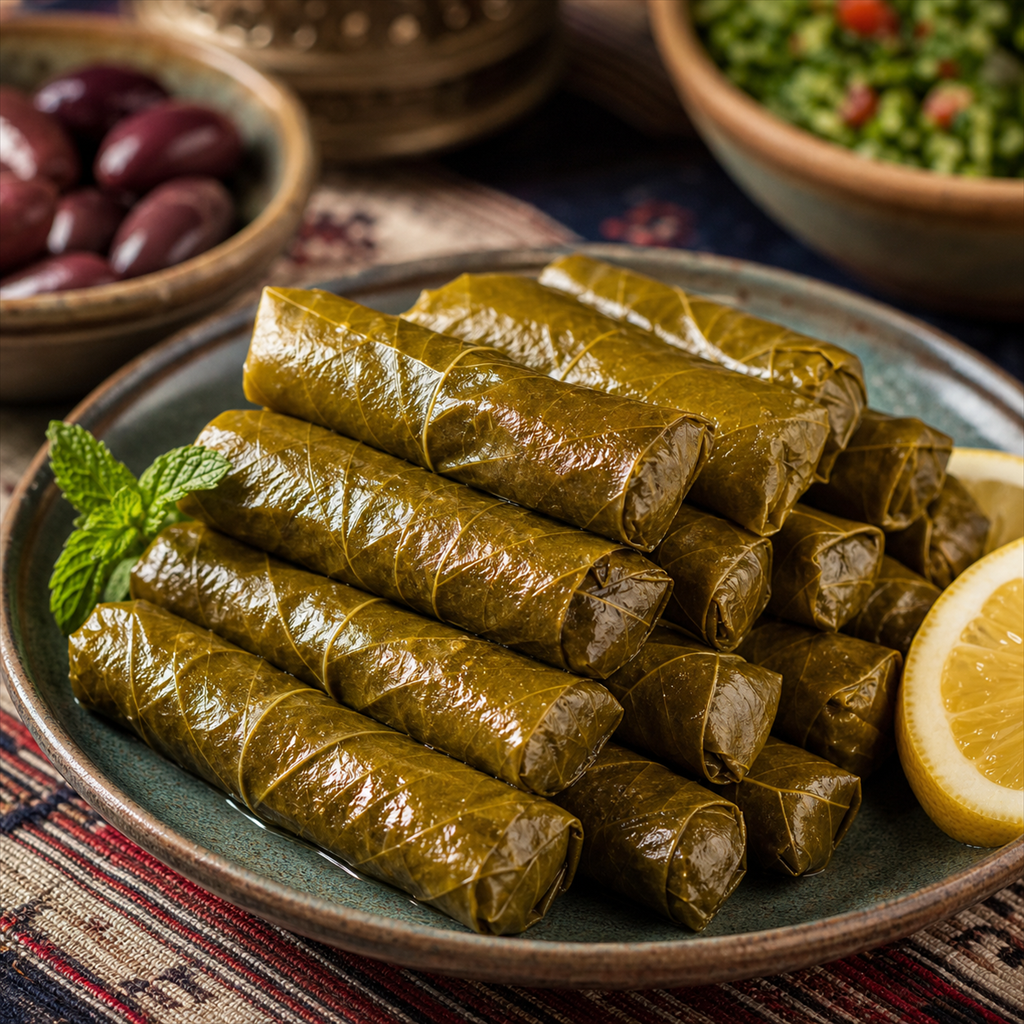
Preparation: 20 min · Cooking: 1 hr 17 min · Total: 1 hr 52 min · 2 servings
Ingredients
- 100 g DRY Egyptian short-grain rice
- 100 g Trimmed fresh tomato
- 10 g Fresh parsley
- WHOLE LARGE food-grade edible FRESH grape leaves, about 15 cm usable span — 20
- 50 g Trimmed yellow onion
- 5 g Fresh mint
- 150 g Peeled RAW potato for lining
- 45 ml Olive oil TOTAL, 30 ml filling + 15 ml cooking
- 45 ml Lemon juice for cooking liquid
- Salt, to taste
- 500 ml Rice rinse/soak water, DISCARDED
- 1000 ml Leaf-blanching water, DISCARDED
- 500 ml Initial cooking water
- 150 ml Hot water MAX braising reserve (optional)
Instructions
Prepare suitable leaves and rice
Use 20 whole LARGE edible food-grade FRESH leaves, about 15 cm usable span, not unidentified foraged or brined leaves. Wash/trim stems, blanch in the 1000 ml allowance from 2 minutes to pliable, discard water. Rinse/soak 100 g dry rice in its separate 500 ml allowance in the fridge for 15 minutes; drain/discard soak water.
Use 20 whole LARGE edible food-grade FRESH leaves, about 15 cm usable span, not unidentified foraged or brined leaves. Wash/trim stems, blanch in the 1000 ml allowance from 2 minutes to pliable, discard water. Rinse/soak 100 g dry rice in its separate 500 ml allowance in the fridge for 15 minutes; drain/discard soak water.
Blanching first check: 120 seconds
Refrigerated rice soak: 900 seconds
Mix the complete filling
Wash/dry produce then finely dice all 100 g tomato/50 g onion and mince 10 g parsley/5 g mint. Mix with drained RAW rice, salt and exactly 30 ml of the TOTAL 45 ml oil. Reserve 15 ml oil for cooking. No raw lamb lining, stock or hidden filling.
Wash/dry produce then finely dice all 100 g tomato/50 g onion and mince 10 g parsley/5 g mint. Mix with drained RAW rice, salt and exactly 30 ml of the TOTAL 45 ml oil. Reserve 15 ml oil for cooking. No raw lamb lining, stock or hidden filling.
Roll with expansion room
Divide actual filling evenly across the 20 appropriately LARGE leaves, vein side up. Fold sides and roll with explicit ROOM FOR RICE EXPANSION, not tightly compressed. Do not force a fixed teaspoon amount or tear undersized leaves; unsuitable leaf/filling fit needs reconciliation, not unlisted extra leaves.
Divide actual filling evenly across the 20 appropriately LARGE leaves, vein side up. Fold sides and roll with explicit ROOM FOR RICE EXPANSION, not tightly compressed. Do not force a fixed teaspoon amount or tear undersized leaves; unsuitable leaf/filling fit needs reconciliation, not unlisted extra leaves.
Line the pot and simmer
Line a compact deep pot, about 16 cm base guide, with all potato in 5 mm rounds; arrange rolls snugly, not crushed. Add 500 ml cooking water, all 45 ml lemon and reserved 15 ml oil. Stabilize gently with a suitable food-safe STOVETOP-HEAT-RATED stainless plate, normal fitted lid, no pressure seal/heavy unsafe weights. Verify cover using at most the 150 ml hot reserve. Simmer gently from a 75-minute first check until leaves, rice and potato are tender.
Line a compact deep pot, about 16 cm base guide, with all potato in 5 mm rounds; arrange rolls snugly, not crushed. Add 500 ml cooking water, all 45 ml lemon and reserved 15 ml oil. Stabilize gently with a suitable food-safe STOVETOP-HEAT-RATED stainless plate, normal fitted lid, no pressure seal/heavy unsafe weights. Verify cover using at most the 150 ml hot reserve. Simmer gently from a 75-minute first check until leaves, rice and potato are tender.
Line the pot and simmer: 4500 seconds
Check centres and lift safely
Check a roll for fully tender rice, not just soft leaf; continue as needed using only remaining measured reserve. Similar-depth pots/batches for larger amounts, not unlimited water or multiplied time. Remove plate carefully with heat-safe utensils. Potato lining prevents sticking, not microbes.
Check a roll for fully tender rice, not just soft leaf; continue as needed using only remaining measured reserve. Similar-depth pots/batches for larger amounts, not unlimited water or multiplied time. Remove plate carefully with heat-safe utensils. Potato lining prevents sticking, not microbes.
Rapidly chill outside the pot
Lift rolls and lining into shallow containers with a little cooking liquid and chill quickly, ideally refrigerating within 1 hour. NEVER wait for the covered cooking pot to become cold. Serve cold only after actual chilling to 4°C or colder; half yields 10 large rolls, fourfold 80 at the same individual size.
Lift rolls and lining into shallow containers with a little cooking liquid and chill quickly, ideally refrigerating within 1 hour. NEVER wait for the covered cooking pot to become cold. Serve cold only after actual chilling to 4°C or colder; half yields 10 large rolls, fourfold 80 at the same individual size.
Respect rice storage limits
Keep at 4°C or colder for at most 24 hours; serve chilled or reheat at most once to 74°C throughout if serving hot. Earlier component deadlines still apply. Do not use room-temperature leaf fermentation or add a meat variant under this oil-only identity.
Keep at 4°C or colder for at most 24 hours; serve chilled or reheat at most once to 74°C throughout if serving hot. Earlier component deadlines still apply. Do not use room-temperature leaf fermentation or add a meat variant under this oil-only identity.
Tips
- Step quantities describe 2 catalogue shares, not guaranteed dietary portions. Scale EVERY numeric input, process-water allowance and garnish by 0.5 for 1 share or 4 for 8 shares. Times, temperatures, thickness, oil depth and pan sizes do not multiply: use suitable comparable-depth vessels or successive base-size batches. Cup 240 ml, tbsp 15 ml, tsp 5 ml; product directions and actual allergens control.
Common mistakes
- Keep perishables at 4°C or colder. Separate raw meat, eggs and flour tools from ready-to-eat food. Refrigerate shallow portions promptly within 2 hours, or 1 hour above 32°C; do not wait for full counter cooling. These are refrigerator-entry deadlines, not a guaranteed cooling curve.
Substitutions
- Keep the specified raw/cooked/prepared states and amounts. Check actual labels and allergens; reconcile incompatible components rather than adding unmeasured ingredients. Never taste raw flour, dough, batter or sealing paste.
Storage
Rapidly cool in shallow portions, ideally refrigerating within 1 hour; keep at 4°C or colder for at most 24 hours. Reheat no more than once to 74°C throughout; unsafe earlier holding cannot be repaired by reheating. Keep perishables at 4°C or colder. Separate raw meat, eggs and flour tools from ready-to-eat food. Refrigerate shallow portions promptly within 2 hours, or 1 hour above 32°C; do not wait for full counter cooling. These are refrigerator-entry deadlines, not a guaranteed cooling curve.
Reheating
Reheat cooked leftovers only once to 74°C throughout, checking representative centres. A timer or browned surface is not enough; respect earlier component deadlines.
About this recipe
Large fresh edible grape leaves filled loosely with rice and herbs over potato lining.
Editorial approval does not establish independent kitchen testing. Check allergens and follow safe food handling.