Sundubu Jjigae
A hot Korean soft-tofu stew with kimchi, pork, egg, and a deeply seasoned broth.
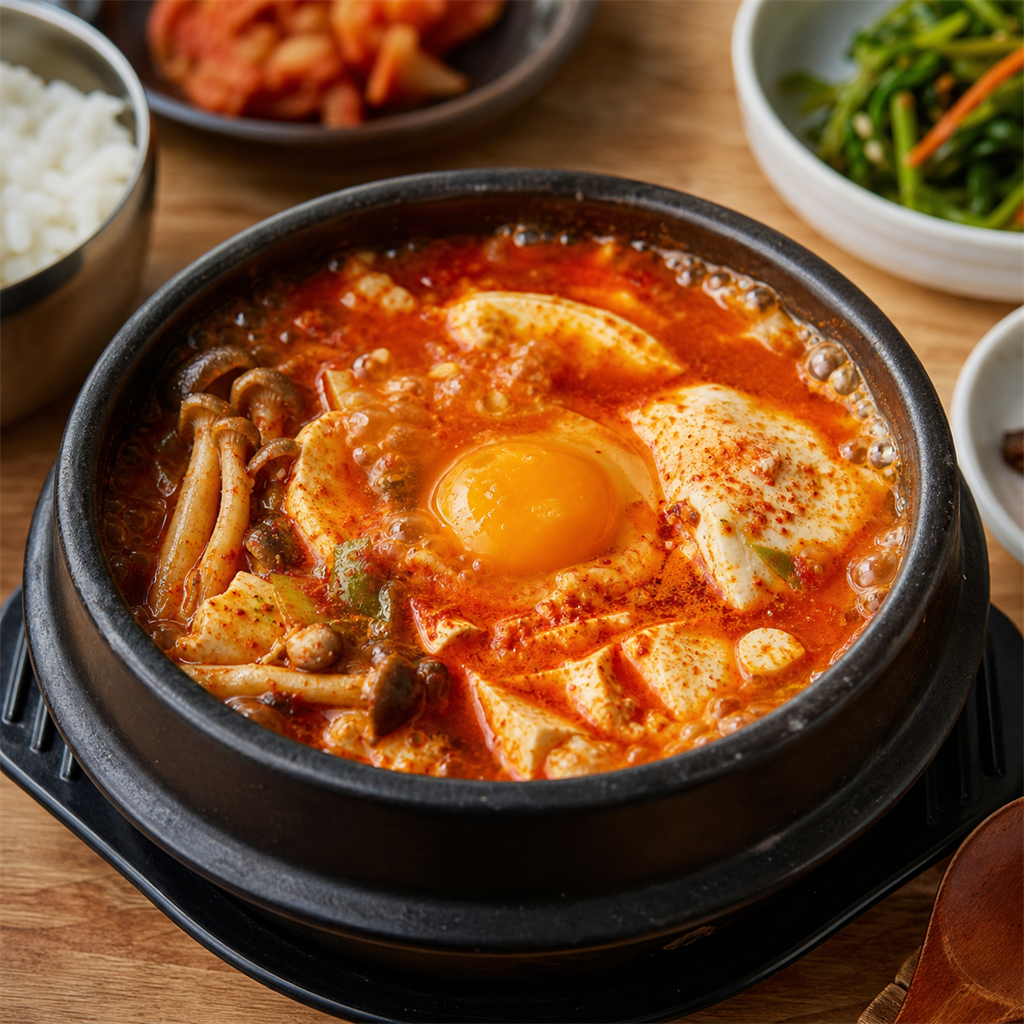
Preparation: 15 min · Cooking: 20 min · Total: 35 min · 4 servings
Ingredients
- 600 g soft tofu — Use Korean soft tofu/sundubu; do not press it.
- 2 tbsp gochugaru — Korean red-pepper flakes; adjust only after tasting.
- 200 g kimchi — Well-fermented napa-cabbage kimchi, chopped; check the label because many contain fish or shellfish.
- 2 pc egg — Use pasteurized eggs if serving anyone at higher risk.
- 60 g scallion — Thinly sliced, divided for cooking and garnish.
- 200 g pork belly — Thinly sliced; keep refrigerated until cooking.
- 1 tbsp neutral oil — Such as grapeseed or sunflower oil.
- 3 clove garlic — Finely minced.
- 100 g yellow onion — Finely diced.
- 150 g zucchini — Halved lengthwise and sliced 5 mm thick.
- 150 g oyster mushrooms (optional) — Torn or sliced; omit only if unavailable.
- 1000 ml anchovy-kelp stock — Or unsalted chicken/vegetable stock.
- 60 ml kimchi brine — Reserved liquid from the kimchi.
- 1 tbsp Korean soup soy sauce — Guk-ganjang; use regular soy sauce only if necessary and reduce to 2 tsp.
- 1 tbsp fish sauce (optional) — Optional; omit for a fish-free broth and add a pinch of salt after tasting.
- 1 tsp toasted sesame oil — For finishing.
- 4 cooked short-grain rice (optional) — Optional, for serving.
Instructions
Organize and measure everything
Set out all ingredients. Keep the pork and eggs refrigerated until needed. Chop the kimchi, dice the onion, mince the garlic, slice the zucchini and mushrooms, and split the scallions between the pot and garnish. Use a separate board and knife for the raw pork, then wash hands, knife, board, and counter before handling ready-to-eat food.
Prepare the ingredients safely
Drain the soft tofu only enough to remove loose packing liquid; leave it in large, delicate pieces. Measure the stock, kimchi brine, soy sauce, fish sauce if using, and sesame oil. Put the rice on to reheat only if it is already cooked; otherwise prepare it separately according to its package. Do not taste the stew with a utensil that has touched raw pork.
Build the kimchi and pork base
Heat the neutral oil in a 3 L heavy pot over medium-low heat. Add gochugaru and stir for 15–20 seconds only, keeping it red and fragrant rather than brown. Add pork and cook, breaking apart slices, until no pink remains and the thickest piece reaches 71°C. Add onion, garlic, kimchi, zucchini, and mushrooms; stir 3–4 minutes until the onion begins to soften.
The pork has no pink areas and its thickest piece reaches 71°C when checked with a clean thermometer.
Simmer the stew
Pour in the stock, kimchi brine, soup soy sauce, and fish sauce if using. Bring just to a boil over medium-high heat, then lower to a lively simmer. Start the preserved 38-minute timer as an outer cooking-and-serving reminder; the stew itself should not be held for all 38 minutes. Simmer uncovered for 5–7 minutes, until zucchini is tender-crisp and the broth tastes rounded, not raw.
Sundubu Jjigae outer timer: 2280 seconds
Add the tofu and eggs
Gently spoon in the soft tofu in large curds; do not stir vigorously. Simmer 2–3 minutes until the tofu is hot throughout. Make two small wells, crack in the eggs, cover, and cook 3–5 minutes until both whites and yolks are firm. Keep the pot away from the edge of the stove and open the lid away from your face to avoid steam burns.
The tofu is hot throughout and remains in soft curds; both egg whites and yolks are firm (71°C if measured).
Check seasoning and doneness
Stir only around the tofu, then taste the broth with a clean spoon. Add a little more kimchi brine or gochugaru only if needed. The pork must be cooked through (71°C if checked); the tofu should be hot and intact; zucchini tender; and eggs fully firm. Do not rely on the timer alone.
Pork is fully cooked, eggs are firm, tofu is hot, and the broth is balanced, spicy, and not bitter.
Serve and store safely
Turn off the heat, drizzle in sesame oil, and scatter over the remaining scallions. Ladle into four heatproof bowls and serve immediately with rice if using. Cool leftovers in shallow containers and refrigerate within 2 hours for up to 3 days. Reheat only once, to 74°C, before serving.
Tips
- Bloom gochugaru briefly in oil; darkening it makes the broth bitter.
- Add the soft tofu near the end and move it gently so it stays silky.
- Kimchi, kimchi brine, soy sauce, and fish sauce vary in saltiness; season after the broth simmers.
Common mistakes
- Burning the gochugaru, which makes the stew bitter.
- Boiling the tofu hard or stirring it vigorously, which breaks its delicate curds.
- Serving soft-cooked egg without a pasteurized egg or a firm 71°C finish.
Substitutions
- Use thinly sliced pork shoulder instead of pork belly.
- Use unsalted vegetable stock and omit fish sauce for a seafood-free broth; taste and add salt as needed.
- Use shiitake mushrooms instead of oyster mushrooms.
Storage
Cool in shallow sealed containers and refrigerate for up to 3 days.
Reheating
Reheat once in a saucepan to 74°C; add a splash of stock if the stew has thickened.
About this recipe
Sundubu jjigae is a beloved Korean stew built around extra-soft tofu. Kimchi, pork, seafood, or vegetables can shape the broth, and it is often served bubbling hot with rice.
Editorial approval does not establish independent kitchen testing. Check allergens and follow safe food handling.