Jordanian Shrak Bread
Four thin unleavened wheat sheets cooked on a stovetop-rated uncoated flat metal griddle.
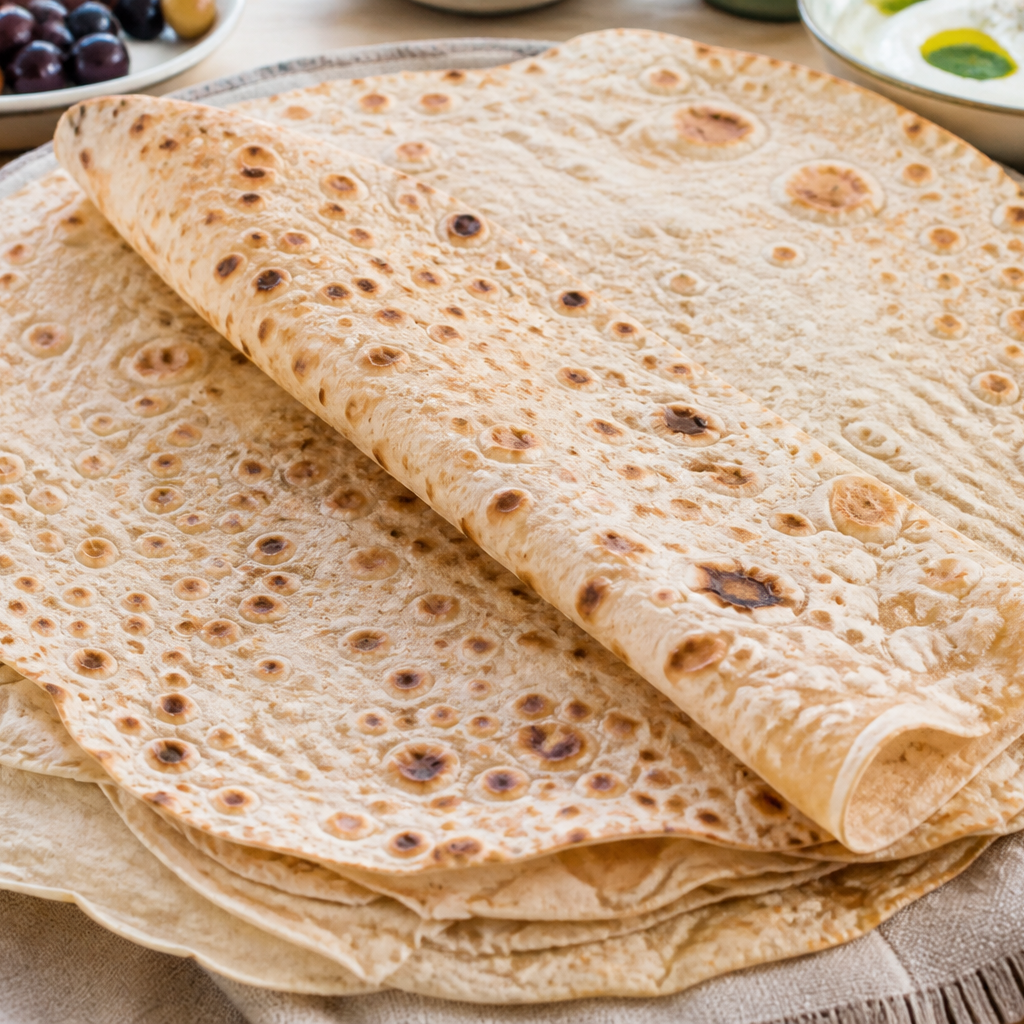
Preparation: 30 min · Cooking: 3 min · Total: 1 hr 41 min · 2 servings
Ingredients
- 200 g White wheat bread flour for active dough
- 150 ml Potable dough water
- 0.5 tsp Fine salt
- 45 g Whole-wheat flour for active dough
- 5 g RESERVED white wheat dusting flour, within 250 g TOTAL flour
Instructions
Measure the complete flour split
Measure 250 g TOTAL flour: 200 g white bread flour plus 45 g whole-wheat for dough, with separate reserved 5 g white dusting flour. Add 150 ml potable water and 0.5 tsp fine salt to active flours only. No inherited yeast or oil. Active dough flour is 245 g, not an exact 60% hydration calculation against all 250 g.
Measure 250 g TOTAL flour: 200 g white bread flour plus 45 g whole-wheat for dough, with separate reserved 5 g white dusting flour. Add 150 ml potable water and 0.5 tsp fine salt to active flours only. No inherited yeast or oil. Active dough flour is 245 g, not an exact 60% hydration calculation against all 250 g.
Knead until elastic
Knead the dough, checking from 10 minutes until smooth and elastic. Never taste raw dough or flour. If the selected flour needs more than the calibrated water, reconcile instead of adding an unbounded hidden top-up.
Knead the dough, checking from 10 minutes until smooth and elastic. Never taste raw dough or flour. If the selected flour needs more than the calibrated water, reconcile instead of adding an unbounded hidden top-up.
Knead until elastic: 600 seconds
Divide and rest four equal portions
Divide ACTUAL dough into four equal portions, not an assumed billiard-ball count. Rest covered on a clean surface for 60 minutes, keeping a clean damp cover away from burners. Half makes 2 sheets, fourfold 16; piece count is separate from 2 catalogue shares.
Divide ACTUAL dough into four equal portions, not an assumed billiard-ball count. Rest covered on a clean surface for 60 minutes, keeping a clean damp cover away from burners. Half makes 2 sheets, fourfold 16; piece count is separate from 2 catalogue shares.
Divide and rest four equal portions: 3600 seconds
Roll thinly with only reserved flour
Use ONLY reserved 5 g dusting flour across all four sheets. Roll/stretch gently to very thin household-griddle sheets about 25–30 cm as a guide. No giant-sheet guarantee, unlisted dusting flour or need to fling dough over arms; keep raw tools away from finished bread.
Use ONLY reserved 5 g dusting flour across all four sheets. Roll/stretch gently to very thin household-griddle sheets about 25–30 cm as a guide. No giant-sheet guarantee, unlisted dusting flour or need to fling dough over arms; keep raw tools away from finished bread.
Heat the specified flat griddle safely
Use a purpose-built STOVETOP-RATED UNCOATED FLAT METAL GRIDDLE per its maker. Heat appropriately over medium-high heat, not an arbitrary inverted pan or an overheated empty non-stick surface. Prepare long-handled heat-safe spatula/tongs and keep all cloth away from burners/griddle.
Use a purpose-built STOVETOP-RATED UNCOATED FLAT METAL GRIDDLE per its maker. Heat appropriately over medium-high heat, not an arbitrary inverted pan or an overheated empty non-stick surface. Prepare long-handled heat-safe spatula/tongs and keep all cloth away from burners/griddle.
Cook both sides with utensils
Lay one thin sheet on the hot griddle. First-side first check is 30 seconds; turn with suitable long-handled heat-safe utensils, NEVER bare fingers or an improvised stick. Second-side first check is 15 seconds. Continue until ALL dough is cooked without raw/gummy centre; brown spots alone are insufficient. Times are per sheet, not a whole-batch guarantee; use more batches at scale.
Lay one thin sheet on the hot griddle. First-side first check is 30 seconds; turn with suitable long-handled heat-safe utensils, NEVER bare fingers or an improvised stick. Second-side first check is 15 seconds. Continue until ALL dough is cooked without raw/gummy centre; brown spots alone are insufficient. Times are per sheet, not a whole-batch guarantee; use more batches at scale.
First-side check, per sheet: 30 seconds
Second-side check, per sheet: 15 seconds
Stack safely off the stove
Lift cooked sheets with clean utensils and briefly release steam before stacking off the stove with a clean dry cloth for softness. No cloth touches burner/griddle. Base 4 sheets split into 2 shares; half uses 100 g white dough flour, 22.5 g whole-wheat and 2.5 g dusting flour, not extra hidden flour.
Lift cooked sheets with clean utensils and briefly release steam before stacking off the stove with a clean dry cloth for softness. No cloth touches burner/griddle. Base 4 sheets split into 2 shares; half uses 100 g white dough flour, 22.5 g whole-wheat and 2.5 g dusting flour, not extra hidden flour.
Store without a pantry-life promise
Refrigerate promptly at 4°C or colder after safe brief steam release and use within the selected 2-day household limit. This is not validated weeks-long pantry preservation. Reheat cooked leftovers once to 74°C if reheating; no raw dough tasting or clock reset at assembly.
Refrigerate promptly at 4°C or colder after safe brief steam release and use within the selected 2-day household limit. This is not validated weeks-long pantry preservation. Reheat cooked leftovers once to 74°C if reheating; no raw dough tasting or clock reset at assembly.
Tips
- Ingredient amounts scale for 1–8 catalogue servings; step quantities describe the base of 2 shares. Halve every numeric input for 1, multiply by four for 8, including process waters, garnish and operating allowances. Time, temperature, thickness and pan depth do not multiply: use matching-depth pans/small batches. Piece yields are separate from shares. Cup = 240 ml, tbsp = 15 ml, tsp = 5 ml. Record bounded optional water/oil adjustments; reconcile if inadequate.
Common mistakes
- Keep perishables at 4°C or colder and raw meat/fish/flour tools separate from ready-to-eat food. Refrigerate shallow portions promptly within 2 hours, or 1 hour above 32°C; do not wait for complete counter cooling. These are refrigeration deadlines, not a guaranteed time for any deep pot to reach 4°C.
Substitutions
- Keep specified raw/cooked/prepared states and measured components. Check actual product labels/allergens and stricter directions; reconcile incompatible products instead of silently replacing them.
Storage
Keep covered at 4°C or colder and use within 2 days or an earlier component-label deadline. This selected household limit is not validated shelf life. Keep perishables at 4°C or colder and raw meat/fish/flour tools separate from ready-to-eat food. Refrigerate shallow portions promptly within 2 hours, or 1 hour above 32°C; do not wait for complete counter cooling. These are refrigeration deadlines, not a guaranteed time for any deep pot to reach 4°C.
Reheating
Reheat cooked leftovers only once to 74°C throughout. Do not repeatedly warm/chill dips or cream-filled pastries, or try to repair earlier unsafe holding by reheating.
About this recipe
Four thin unleavened wheat sheets cooked on a stovetop-rated uncoated flat metal griddle.
Editorial approval does not establish independent kitchen testing. Check allergens and follow safe food handling.