Aqaba Sayadiyah
Long-grain rice in measured recovered onion broth with fried sea bass and ready-to-eat pine nuts.
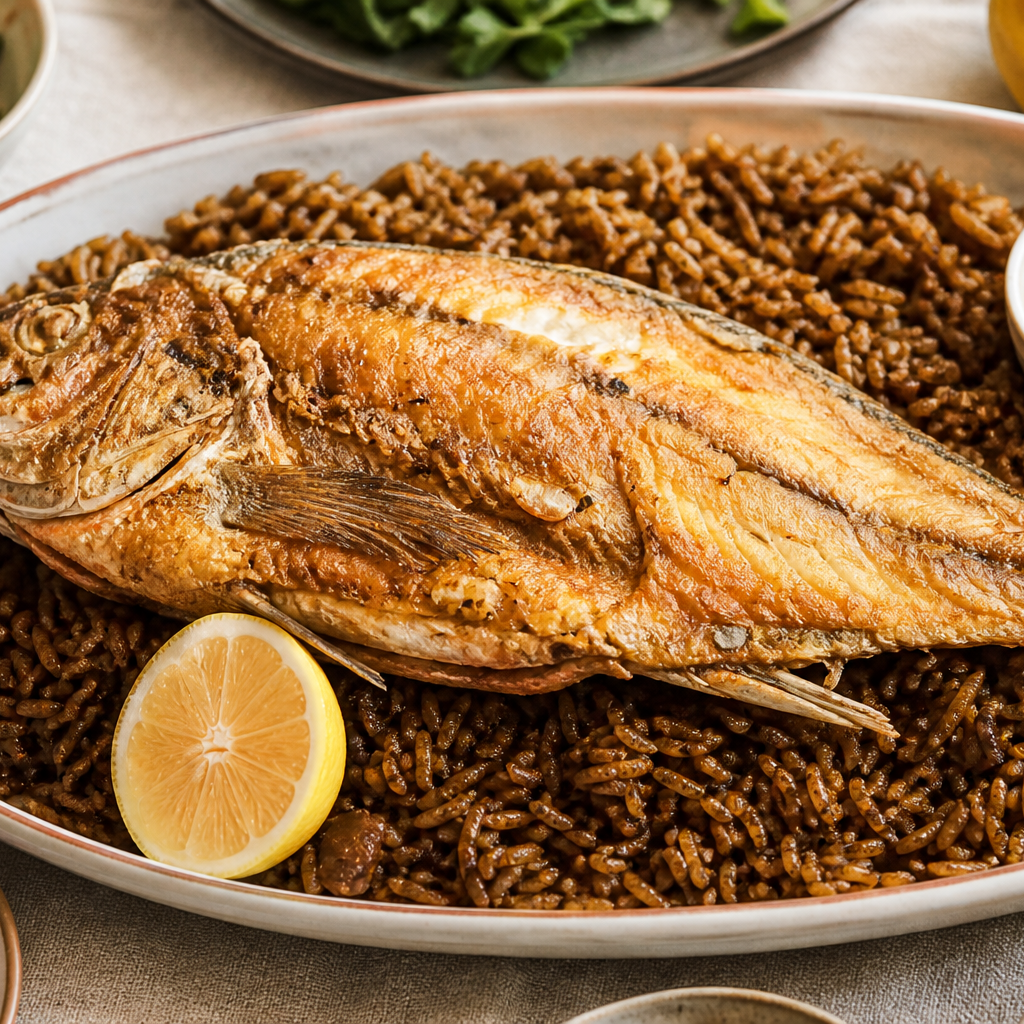
Preparation: 30 min · Cooking: 58 min · Total: 1 hr 38 min · 2 servings
Ingredients
- 300 g RAW boneless sea-bass fillets
- 200 g DRY long-grain rice
- 300 g Trimmed onion
- 0.5 tsp Ground cumin
- 0.5 tsp Ground coriander seed
- Salt, to taste
- 30 ml Vegetable oil for onions ONLY
- 240 ml SEPARATE fish-frying oil, operating allowance
- 15 g Wheat flour dusting allowance for fish
- 10 g Commercial RTE toasted pine nuts
- 720 ml Initial onion extraction water
- 750 ml Rice rinse water, discarded
- 150 ml Optional SHARED hot stock/rice water, maximum (optional)
Instructions
Prepare separately from raw fish
Wash/chop 300 g trimmed onion and rinse 200 g DRY rice with separate 750 ml water; drain and discard rinse water. Keep 300 g RAW boneless sea-bass fillets at 4°C or colder and pat dry with separate tools. Season fish with 0.5 tsp each cumin/coriander and salt; follow earlier fish-label deadlines.
Wash/chop 300 g trimmed onion and rinse 200 g DRY rice with separate 750 ml water; drain and discard rinse water. Keep 300 g RAW boneless sea-bass fillets at 4°C or colder and pat dry with separate tools. Season fish with 0.5 tsp each cumin/coriander and salt; follow earlier fish-label deadlines.
Brown onions without burning
Heat ONLY the 30 ml onion oil over medium heat. Cook onions, checking from 20 minutes until deep gold/brown without blackening or bitterness; dark chocolate colour is not mandatory. The separate 240 ml fish-frying bath is NOT this pan.
Heat ONLY the 30 ml onion oil over medium heat. Cook onions, checking from 20 minutes until deep gold/brown without blackening or bitterness; dark chocolate colour is not mandatory. The separate 240 ml fish-frying bath is NOT this pan.
Brown onions without burning: 1200 seconds
Extract broth without an oil-water splash
Remove onion pan from heat and let active frying subside. Gradually add all 720 ml measured HOT extraction water close to the pot with steam/splash protection; NEVER add water to the separate fish-frying bath. Bring to a boil and simmer from 15 minutes. This is onion broth, not a hidden skin/bone stock method.
Remove onion pan from heat and let active frying subside. Gradually add all 720 ml measured HOT extraction water close to the pot with steam/splash protection; NEVER add water to the separate fish-frying bath. Bring to a boil and simmer from 15 minutes. This is onion broth, not a hidden skin/bone stock method.
Extract broth without an oil-water splash: 900 seconds
Measure derived onion broth once
Strain and measure 400 ml onion broth FROM initial 720 ml extraction (half 200 ml, fourfold 1600 ml). Record shortfall from the SAME optional shared hot reserve up to 150 ml, leaving its remainder for rice adjustment. Surplus extraction/pulp are outside this formula; do not pour all 720 ml into 200 g rice or add another broth-shopping line.
Strain and measure 400 ml onion broth FROM initial 720 ml extraction (half 200 ml, fourfold 1600 ml). Record shortfall from the SAME optional shared hot reserve up to 150 ml, leaving its remainder for rice adjustment. Surplus extraction/pulp are outside this formula; do not pour all 720 ml into 200 g rice or add another broth-shopping line.
Fry fish to its own safety check
Dust fish using only the 15 g flour allowance and discard raw-fish-contaminated flour leftovers. Heat SEPARATE 240 ml operating oil to 175°C in suitable deep cookware with safe headroom. Fry uncrowded, checking from 3 minutes, turning/continuing for thickness until 63°C, opaque and easily flaking with cooked coating. Record equipment-driven oil adjustment; keep cooked fish at 60°C or above with clean tools.
Dust fish using only the 15 g flour allowance and discard raw-fish-contaminated flour leftovers. Heat SEPARATE 240 ml operating oil to 175°C in suitable deep cookware with safe headroom. Fry uncrowded, checking from 3 minutes, turning/continuing for thickness until 63°C, opaque and easily flaking with cooked coating. Record equipment-driven oil adjustment; keep cooked fish at 60°C or above with clean tools.
Fry fish to its own safety check: 180 seconds
Cook rice in measured recovered broth
Bring measured recovered 400 ml broth and drained rice to a boil, cover with a normal fitted lid and simmer low, checking from 20 minutes until rice fully tender according to its label. Record only remaining shared hot reserve if needed; reconcile if inadequate. Use matching-depth pans at scale, not one deeper fourfold pot.
Bring measured recovered 400 ml broth and drained rice to a boil, cover with a normal fitted lid and simmer low, checking from 20 minutes until rice fully tender according to its label. Record only remaining shared hot reserve if needed; reconcile if inadequate. Use matching-depth pans at scale, not one deeper fourfold pot.
Cook rice in measured recovered broth: 1200 seconds
Rest and plate with measured nuts
Rest fully cooked rice off heat covered for 10 minutes. Plate rice/fish using clean tools, add all 10 g RTE toasted pine nuts and divide into 2 catalogue shares. Operating oil and flour allowances are not all assumed eaten; no tahini or unlisted garnish is included.
Rest fully cooked rice off heat covered for 10 minutes. Plate rice/fish using clean tools, add all 10 g RTE toasted pine nuts and divide into 2 catalogue shares. Operating oil and flour allowances are not all assumed eaten; no tahini or unlisted garnish is included.
Rest and plate with measured nuts: 600 seconds
Chill shallow rice and fish portions
Chill leftovers promptly, ideally into a fridge at 4°C or colder within 1 hour. Use within 24 hours or earlier fish/component deadline and reheat only once to 74°C. Reheating does not undo earlier unsafe storage.
Chill leftovers promptly, ideally into a fridge at 4°C or colder within 1 hour. Use within 24 hours or earlier fish/component deadline and reheat only once to 74°C. Reheating does not undo earlier unsafe storage.
Tips
- Ingredient amounts scale for 1–8 catalogue servings; step quantities describe the base of 2 shares. Halve every numeric input for 1, multiply by four for 8, including process waters, garnish and operating allowances. Time, temperature, thickness and pan depth do not multiply: use matching-depth pans/small batches. Piece yields are separate from shares. Cup = 240 ml, tbsp = 15 ml, tsp = 5 ml. Record bounded optional water/oil adjustments; reconcile if inadequate.
Common mistakes
- Keep perishables at 4°C or colder and raw meat/fish/flour tools separate from ready-to-eat food. Refrigerate shallow portions promptly within 2 hours, or 1 hour above 32°C; do not wait for complete counter cooling. These are refrigeration deadlines, not a guaranteed time for any deep pot to reach 4°C.
Substitutions
- Keep specified raw/cooked/prepared states and measured components. Check actual product labels/allergens and stricter directions; reconcile incompatible products instead of silently replacing them.
Storage
Chill shallow portions promptly, ideally refrigerating within 1 hour at 4°C or colder. Use within 24 hours and reheat once to 74°C throughout. Earlier component deadlines still apply; assembly does not reset them. Keep perishables at 4°C or colder and raw meat/fish/flour tools separate from ready-to-eat food. Refrigerate shallow portions promptly within 2 hours, or 1 hour above 32°C; do not wait for complete counter cooling. These are refrigeration deadlines, not a guaranteed time for any deep pot to reach 4°C.
Reheating
Reheat cooked leftovers only once to 74°C throughout. Do not repeatedly warm/chill dips or cream-filled pastries, or try to repair earlier unsafe holding by reheating.
About this recipe
Long-grain rice in measured recovered onion broth with fried sea bass and ready-to-eat pine nuts.
Editorial approval does not establish independent kitchen testing. Check allergens and follow safe food handling.