Sangak-Style Whole Wheat Tray Flatbread
A high-hydration instant-yeast home-tray adaptation, without loose stones.
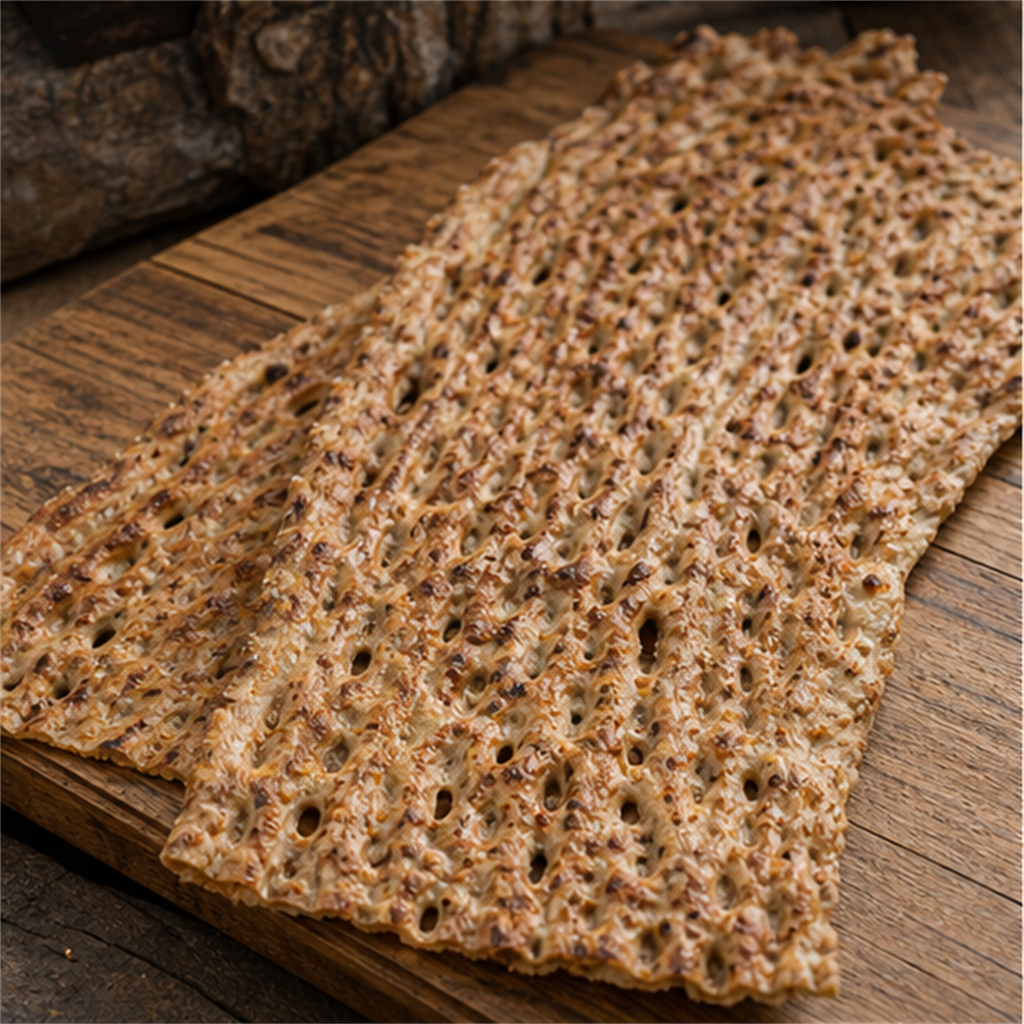
Preparation: 15 min · Cooking: 15 min · Total: 2 hr 30 min · 2 servings
Ingredients
- 200 g Whole-wheat flour
- 0.5 tsp Instant yeast
- 0.5 tsp Salt
- 160 ml Initial warm dough water
- 1 tsp Sesame seeds
- 10 ml Maximum additional dough water, only if needed (optional) — Base total dough water must not exceed 170 ml per 200 g flour; this is an 80–85% hydration adaptation.
- 30 ml Separate hand-wetting water allowance — Not all added to the dough. Never pour onto hot equipment.
Instructions
Mix the dry ingredients
Mix whole-wheat flour, instant yeast and salt in a bowl. This version uses instant yeast, not a sourdough starter. Use the scaled ingredient list for 1–8 servings; step quantities describe the 2-serving base. Halve every allowance for one serving, multiply by four for eight, and keep the same thickness and per-batch checks. Cups are 240 ml, tablespoons 15 ml and teaspoons 5 ml.
This version uses instant yeast, not a sourdough starter.
Control the dough water
Add initial warm water according to yeast instructions and mix from 5 minutes. Add measured reserve only if needed for a slack, stretchable dough; record use. Cap base water at 160 + 10 = 170 ml per 200 g flour; half is 80 + 5 ml and fourfold 640 + 40 ml.
Cap base water at 160 + 10 = 170 ml per 200 g flour; half is 80 + 5 ml and fourfold 640 + 40 ml.
Control the dough water: 300 seconds
Proof until aerated
Cover the bowl and proof at room temperature, checking from 2 hours until visibly expanded and aerated. Time alone does not establish readiness; do not taste raw dough.
Time alone does not establish readiness; do not taste raw dough.
Proof until aerated: 7200 seconds
Prepare oven-rated equipment
Preheat a conventional oven to 250°C. Use an uncoated food-contact heavy baking tray rated for 250°C; no pebbles, river stones, marbles, unmarked liners or self-cleaning mode.
Use an uncoated food-contact heavy baking tray rated for 250°C; no pebbles, river stones, marbles, unmarked liners or self-cleaning mode.
Shape on the cool tray
Use a little of the separate handling water on hands and stretch one thin loaf on the cool tray. Sprinkle measured sesame; do not pour water onto hot equipment. Half makes one smaller loaf; fourfold makes four base-sized loaves in batches.
Half makes one smaller loaf; fourfold makes four base-sized loaves in batches.
Bake and check the centre
Bake at 250°C, beginning checks from 8 minutes. Continue until the bread is browned and fully baked through, with no raw or gummy layer; surface blisters alone are insufficient.
Continue until the bread is browned and fully baked through, with no raw or gummy layer; surface blisters alone are insufficient.
Bake and check the centre: 480 seconds
Cool a test piece
Lift the tray with oven gloves and cool a small cut piece before checking its crumb. Return the loaf to the oven if the centre is gummy; never sample raw dough.
Return the loaf to the oven if the centre is gummy; never sample raw dough.
Serve the home-tray version
Cool bread on a rack before packing airtight. This is Sangak-style home-tray bread, not a claim of identical pebble-baked dimples or guaranteed results for every flour.
This is Sangak-style home-tray bread, not a claim of identical pebble-baked dimples or guaranteed results for every flour.
Tips
- Use the scaled ingredient list for 1–8 servings; step quantities describe the 2-serving base. Halve every allowance for one serving, multiply by four for eight, and keep the same thickness and per-batch checks. Cups are 240 ml, tablespoons 15 ml and teaspoons 5 ml.
Common mistakes
- Timers are first checks, not guarantees; follow this recipe’s actual texture and temperature checks. Keep the approved ingredient allocations separate.
Substitutions
- Use only the listed ingredients and preparation states; no unmeasured substitution is approved for this master.
Storage
Cool bread completely on a rack, then store airtight for up to 2 days. This is a selected quality limit, not a preservation study.
Reheating
Warm already-baked bread briefly in a dry skillet over medium-low heat; do not add unlisted fat.
About this recipe
A high-hydration instant-yeast home-tray adaptation, without loose stones.
Editorial approval does not establish independent kitchen testing. Check allergens and follow safe food handling.