Emirati Samak Mashwi
Butterflied sea bream with coriander, lime and Bezar, cooked on a griddle.
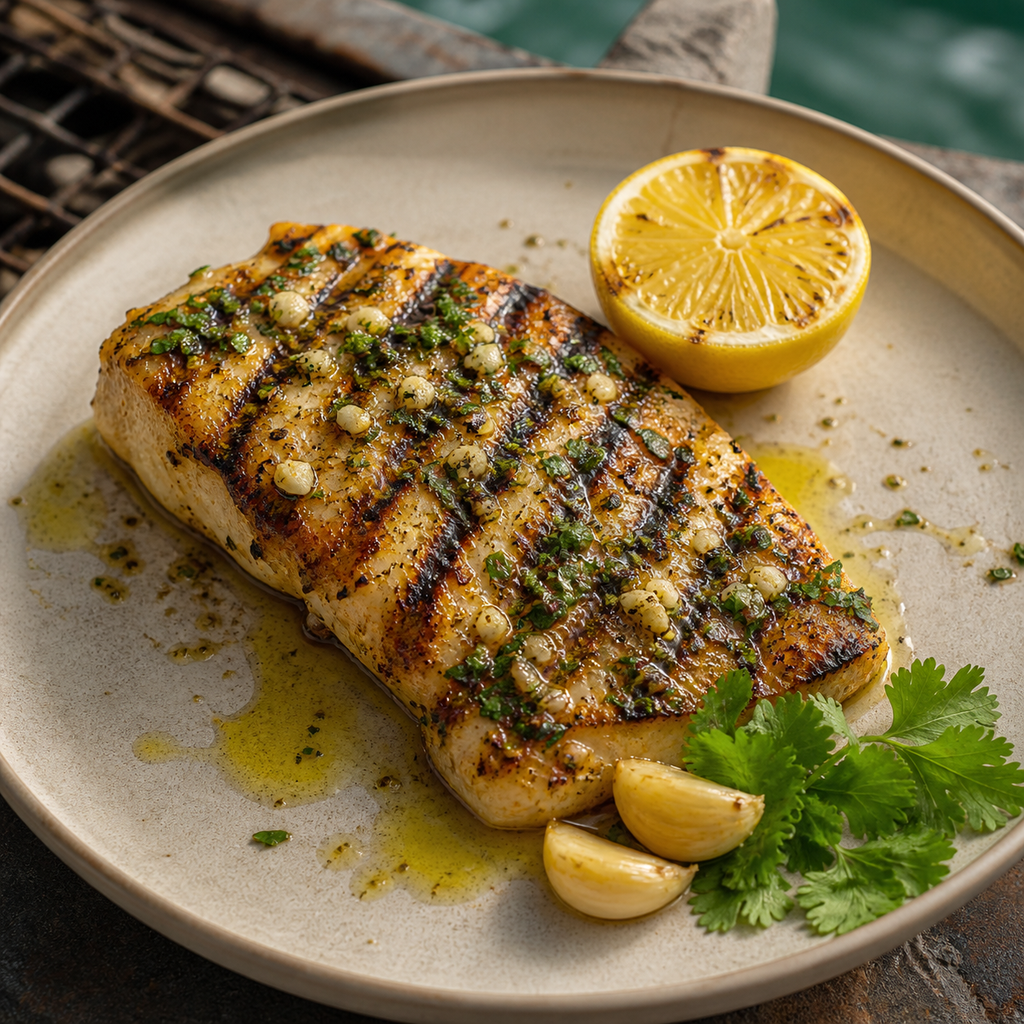
Preparation: 20 min · Cooking: 15 min · Total: 55 min · 4 servings
Ingredients
- garlic cloves — 6
- 30 g fresh coriander leaves
- whole sea bream, cleaned and butterflied — 2 — About 500 g each; ask the fishmonger to gut, scale and butterfly.
- 1.5 tbsp Emirati Bezar spice blend
- 1 tsp ground cumin
- 1 tsp ground turmeric
- 1 tsp salt
- 50 ml fresh lime juice
- 2 tbsp vegetable oil for brushing the griddle
Instructions
Measure fish and seasonings
For 4 servings use 2 fish of about 500 g each; for 16 use 8 fish. Measure all seasonings, lime juice and the single 2 tbsp oil allowance before handling fish.
Measure all seasonings, lime juice and the single 2 tbsp oil allowance before handling fish.
Prepare the griddle setup
Use fish already cleaned, scaled and butterflied by the fishmonger. Pat dry without spray-rinsing raw fish; prepare separate utensils, a clean serving plate and a probe thermometer.
Pat dry without spray-rinsing raw fish; prepare separate utensils, a clean serving plate and a probe thermometer.
Make the coriander paste
Grind garlic, fresh coriander, Bezar, cumin, turmeric, salt and lime juice into a spreadable paste. Coat the exposed flesh evenly, without using the griddle oil in the marinade.
Coat the exposed flesh evenly, without using the griddle oil in the marinade.
Marinate under refrigeration
Cover and refrigerate the coated fish at 4°C or colder for 15 minutes. Near the end, preheat the griddle over medium-high heat; do not marinate at room temperature.
Near the end, preheat the griddle over medium-high heat; do not marinate at room temperature.
Marinate under refrigeration: 900 seconds
Cook both sides continuously
Brush the hot griddle with the measured oil, sharing it across all fish. Cook skin-side down for about 5–6 minutes, then carefully turn and cook the flesh side for about 4–5 minutes. Work in comparable batches without partially cooked holding.
Work in comparable batches without partially cooked holding.
Cook both sides continuously: 300 seconds
Verify the thickest flesh
Check several thick areas away from bone with a clean thermometer: at least 63°C, opaque flesh that flakes easily. Continue cooking as needed; neither the timer nor browned skin proves doneness.
Continue cooking as needed; neither the timer nor browned skin proves doneness.
Serve with care around bones
Transfer fully cooked fish to the clean plate and serve promptly. Warn diners that whole fish contains bones; use clean serving utensils rather than raw-fish tools.
Warn diners that whole fish contains bones; use clean serving utensils rather than raw-fish tools.
Cool and store leftovers
Divide leftovers promptly into shallow containers and refrigerate within 1 hour at 4°C or colder; do not wait for a deep pot to cool to room temperature. Use within 24 hours. This conservative household limit does not validate shelf life or repair unsafe handling.
This conservative household limit does not validate shelf life or repair unsafe handling.
Tips
- Quantities and divided allowances in the instructions describe the base batch. Scale them with the ingredient controls, not the cooking times; use multiple comparable pans or batches for a larger yield.
Common mistakes
- Do not treat a timer, colour or aroma alone as proof of readiness. Follow the stated texture and thermometer checks.
Substitutions
- The same measured amount of ghee may replace the vegetable oil; ghee contains milk. Do not replace lime juice with whole lemon by weight.
Storage
Divide leftovers promptly into shallow containers and refrigerate within 1 hour at 4°C or colder; do not wait for a deep pot to cool to room temperature. Use within 24 hours. This conservative household limit does not validate shelf life or repair unsafe handling.
Reheating
Reheat at most once to 74°C throughout, checking several centres. Reheating cannot make improperly stored food safe.
About this recipe
Samak Mashwi is grilled fish. This Emirati version uses a coriander-lime spice paste and a hot griddle; the catalogue makes no exclusive origin or local species-equivalence claim.
Editorial approval does not establish independent kitchen testing. Check allergens and follow safe food handling.