Lebanese Rose Semolina Pudding
Cooked coarse semolina and milk, chilled before an Ashta and pistachio topping.
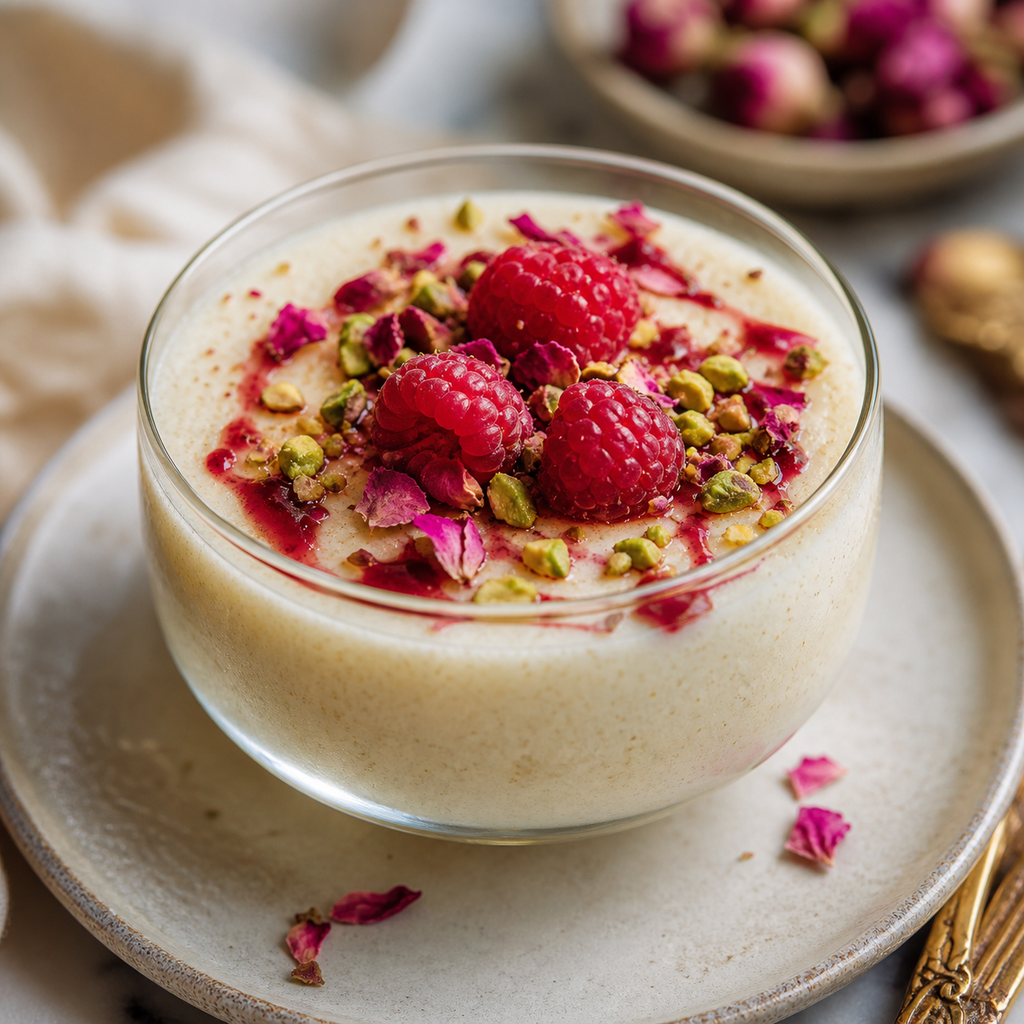
23 min hands-on + 3 hr 30 min chilling · Total: 3 hr 53 min · 2 servings
Ingredients
- 500 ml Pasteurized whole milk
- 25 g Granulated sugar
- 5 ml Food-grade rosewater
- 30 g RTE crushed pistachios
- 100 g RAW coarse wheat semolina
- 5 ml Food-grade orange-blossom water
- 150 g Chilled pasteurized commercially RTE thick Ashta
- 40 ml Prepared RTE plain sugar syrup for serving (optional)
Instructions
Whisk into cold milk
Use 100 g COARSE semolina, not the old fine-grain formula. Whisk all semolina and sugar into the 500 ml cold milk. Do not taste raw semolina/batter; check cream and nut labels for RTE suitability and allergens.
Use 100 g COARSE semolina, not the old fine-grain formula. Whisk all semolina and sugar into the 500 ml cold milk. Do not taste raw semolina/batter; check cream and nut labels for RTE suitability and allergens.
Cook and prepare the dish
Place on medium heat and stir continuously, including corners, to avoid scorching. Prepare a heat-compatible shallow METAL container around 20 × 15 cm for the base batch and a pudding depth at most about 2 cm. Do not pour boiling pudding into cold unverified ceramic.
Place on medium heat and stir continuously, including corners, to avoid scorching. Prepare a heat-compatible shallow METAL container around 20 × 15 cm for the base batch and a pudding depth at most about 2 cm. Do not pour boiling pudding into cold unverified ceramic.
Check fully cooked pudding
Check from 8 minutes, stirring, until semolina is fully cooked and thick with gentle bubbling. Follow stricter grain directions; a timer alone is not the endpoint. Remove from heat.
Check from 8 minutes, stirring, until semolina is fully cooked and thick with gentle bubbling. Follow stricter grain directions; a timer alone is not the endpoint. Remove from heat.
Check fully cooked pudding: 480 seconds
Scent off heat
Stir in exactly 5 ml rosewater and 5 ml orange-blossom water off heat. Pour into the prepared shallow metal dish and level with a clean utensil; no raspberries or pomegranate molasses.
Stir in exactly 5 ml rosewater and 5 ml orange-blossom water off heat. Pour into the prepared shallow metal dish and level with a clean utensil; no raspberries or pomegranate molasses.
Chill the base promptly
Cool promptly in shallow portions and refrigerate without waiting for a fixed 30-minute counter cool. Check actual temperature with a clean thermometer: base must be 4°C or colder BEFORE cream. A 30-minute refrigerator reminder is only a first check; continue chilling as needed, never a promised cooling curve.
Cool promptly in shallow portions and refrigerate without waiting for a fixed 30-minute counter cool. Check actual temperature with a clean thermometer: base must be 4°C or colder BEFORE cream. A 30-minute refrigerator reminder is only a first check; continue chilling as needed, never a promised cooling curve.
Chill the base promptly: 1800 seconds
Add cold RTE topping
Only once the base is actually at 4°C or colder, spread all 150 g cold RTE Ashta and all 30 g RTE pistachios using clean tools. Do not use raw/uncooked dairy cream substitutes or a hot base.
Only once the base is actually at 4°C or colder, spread all 150 g cold RTE Ashta and all 30 g RTE pistachios using clean tools. Do not use raw/uncooked dairy cream substitutes or a hot base.
Chill the assembled dessert
Cover and refrigerate at 4°C or colder for at least 3 hours AFTER topping. Estimated elapsed time includes the base-cooling first check plus this chill; actual cooling may take longer. Use more shallow containers for larger batches, not a deeper pudding layer.
Cover and refrigerate at 4°C or colder for at least 3 hours AFTER topping. Estimated elapsed time includes the base-cooling first check plus this chill; actual cooling may take longer. Use more shallow containers for larger batches, not a deeper pudding layer.
Chill the assembled dessert: 10800 seconds
Cut and serve cold
Cut base batch into four modest squares (2 catalogue shares); half gives 2, fourfold 16 comparable pieces. Serve cold, using the optional measured 40 ml prepared syrup if desired. Keep refrigerated at most 2 days or earlier Ashta/ingredient deadline; no reheating and no clock reset by topping.
Cut base batch into four modest squares (2 catalogue shares); half gives 2, fourfold 16 comparable pieces. Serve cold, using the optional measured 40 ml prepared syrup if desired. Keep refrigerated at most 2 days or earlier Ashta/ingredient deadline; no reheating and no clock reset by topping.
Tips
- Step quantities describe 2 catalogue shares, not guaranteed dietary portions. Scale EVERY numeric input, process-water allowance and garnish by 0.5 for 1 share or 4 for 8 shares. Times, temperatures, thickness, oil depth and pan sizes do not multiply: use suitable comparable-depth vessels or successive base-size batches. Cup 240 ml, tbsp 15 ml, tsp 5 ml; product directions and actual allergens control.
Common mistakes
- Keep perishables at 4°C or colder. Separate raw meat, eggs and flour tools from ready-to-eat food. Refrigerate shallow portions promptly within 2 hours, or 1 hour above 32°C; do not wait for full counter cooling. These are refrigerator-entry deadlines, not a guaranteed cooling curve.
Substitutions
- Keep the specified raw/cooked/prepared states and amounts. Check actual labels and allergens; reconcile incompatible components rather than adding unmeasured ingredients. Never taste raw flour, dough, batter or sealing paste.
Storage
Keep covered at 4°C or colder for at most 2 days or earlier component-label deadline. This selected household cap is not validated shelf life; assembly does not reset an older ingredient clock. Keep perishables at 4°C or colder. Separate raw meat, eggs and flour tools from ready-to-eat food. Refrigerate shallow portions promptly within 2 hours, or 1 hour above 32°C; do not wait for full counter cooling. These are refrigerator-entry deadlines, not a guaranteed cooling curve.
Reheating
Serve chilled as directed; do not repeatedly warm and cool ready-to-eat food. Follow an earlier ingredient use-by limit.
About this recipe
Cooked coarse semolina and milk, chilled before an Ashta and pistachio topping.
Editorial approval does not establish independent kitchen testing. Check allergens and follow safe food handling.