Quiche Lorraine
A savory tart from Lorraine with crisp pastry, smoked bacon and baked egg-cream custard.
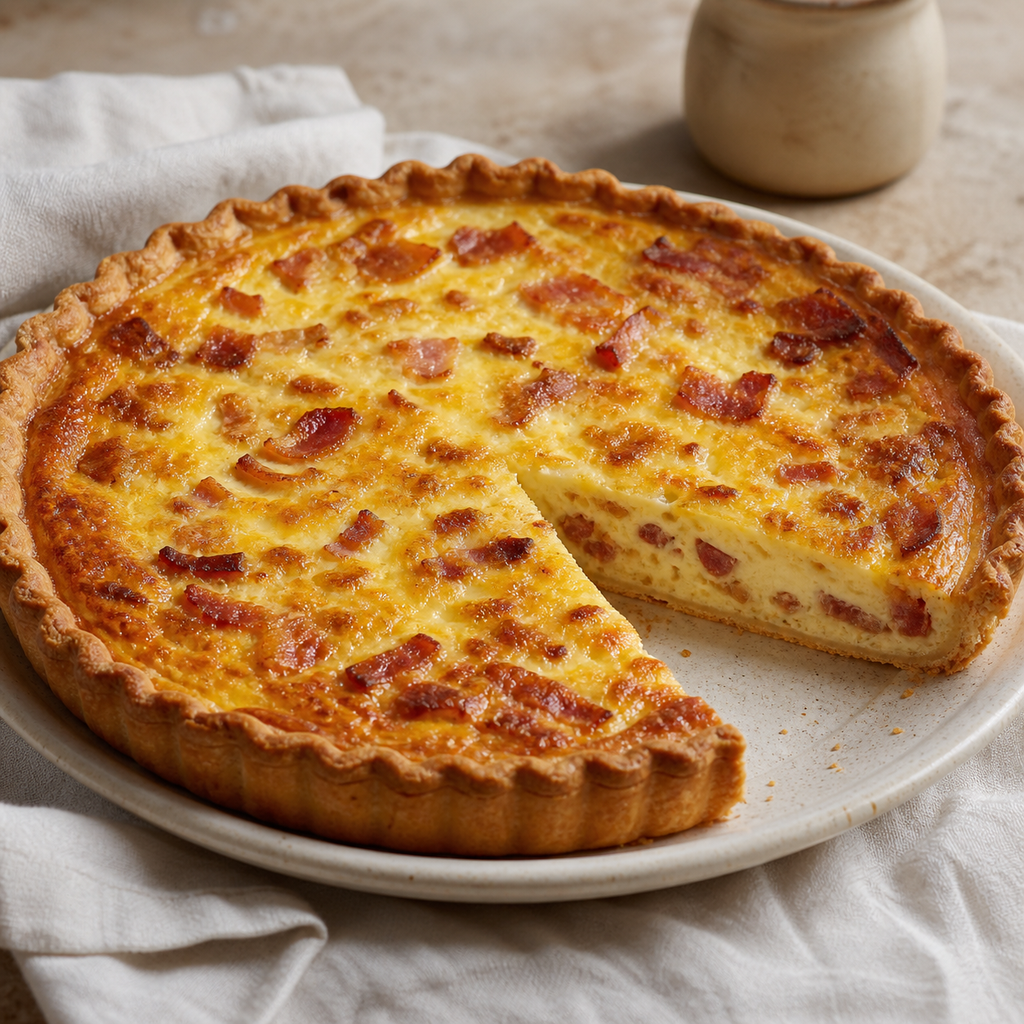
Preparation: 25 min · Cooking: 38 min · Total: 1 hr 15 min · 6 servings
Ingredients
- 320 g ready-rolled shortcrust pastry — One 23 cm round sheet.
- 4 eggs — About 200 g without shells.
- 300 ml heavy cream — At least 35% fat.
- 200 g smoked bacon lardons — Pork bacon; use diced smoked bacon.
- 100 g Gruyère cheese (optional) — Optional: cheese is common today but not part of the oldest Quiche Lorraine formula.
- 100 ml whole milk
- 0.3 tsp ground black pepper
- 0.1 tsp ground nutmeg
Instructions
Preheat and organise safely
Heat the oven to 190°C conventional (170°C fan). Place a baking sheet inside to heat. Take the pastry from the refrigerator only when ready to line the tin. Keep the raw bacon refrigerated and use a separate board, knife and plate for it. Traditional Quiche Lorraine uses pork bacon; choose a smoked non-pork bacon only if needed, knowing it changes the traditional flavour.
Line and blind-bake the pastry
Lightly press the pastry into a 23 cm tart tin, trimming the edge but leaving a 1 cm overhang for shrinkage. Prick the base with a fork. Line with parchment and fill with pie weights or dry beans. Bake on the hot sheet for 15 minutes, then remove paper and weights and bake 5 more minutes until the base looks dry and pale golden. Reduce the oven to 180°C conventional (160°C fan).
Cook the bacon and make the custard
While the crust bakes, cook bacon lardons in a dry skillet over medium heat for 5–7 minutes until browned and its fat has rendered. Drain on a paper-lined plate; do not pour hot fat into the sink. In a clean bowl, whisk eggs, cream, milk, pepper and nutmeg until evenly combined. Stir in the cooled bacon. Keep the bowl and whisk away from raw-bacon utensils.
Fill and bake the quiche
Scatter the optional Gruyère over the warm pastry shell, then pour in the egg mixture. Put the tin on the preheated sheet. Start the retained 28-minute baking timer and bake until the edges are puffed and golden. If the centre is still liquid after 28 minutes, continue 5 minutes at a time until it is set; do not use the timer as the only cue.
Bake the quiche: 1680 seconds
Rest and portion
Transfer the quiche to a rack and rest 10 minutes before removing the tin ring or slicing. This lets the hot custard finish setting and makes clean portions. Cut into 6 wedges with a clean knife and serve warm, not piping hot.
Check that the custard is set
The filling must look set at the edges and only wobble gently in a 2–3 cm circle at the centre when the tin is nudged; it must not slosh. A thermometer inserted into the centre should read 71°C. The crust should be crisp and golden underneath, not pale or doughy. Return it to the oven in 5-minute intervals if either cue is not met.
The custard is set at the edges and only gently wobbles in a small centre circle; it reaches 71°C and the crust is crisp and golden.
Serve and store safely
Serve immediately. Refrigerate remaining wedges in a covered shallow container within 2 hours and use within 2 days. Reheat individual wedges on a tray at 160°C until the centre reaches 74°C; do not leave the whole quiche at room temperature for a long buffet.
Tips
- Bake the empty pastry shell on a preheated sheet; the direct heat helps prevent a soggy base.
Common mistakes
- Pouring filling into an unbaked shell makes the base soft.
- Slicing immediately lets hot custard run out; rest the quiche for the full 10 minutes.
Substitutions
- Use diced smoked turkey bacon for a non-pork version, but describe it as a variation rather than traditional Quiche Lorraine.
Storage
Cover and refrigerate leftover wedges within 2 hours; use within 2 days.
Reheating
Reheat wedges on a tray at 160°C until the centre reaches 74°C.
About this recipe
Quiche Lorraine comes from the Lorraine region of northeastern France. Its classic filling is egg, cream and pork bacon; cheese is a later, popular addition rather than a requirement in the oldest version.
Editorial approval does not establish independent kitchen testing. Check allergens and follow safe food handling.