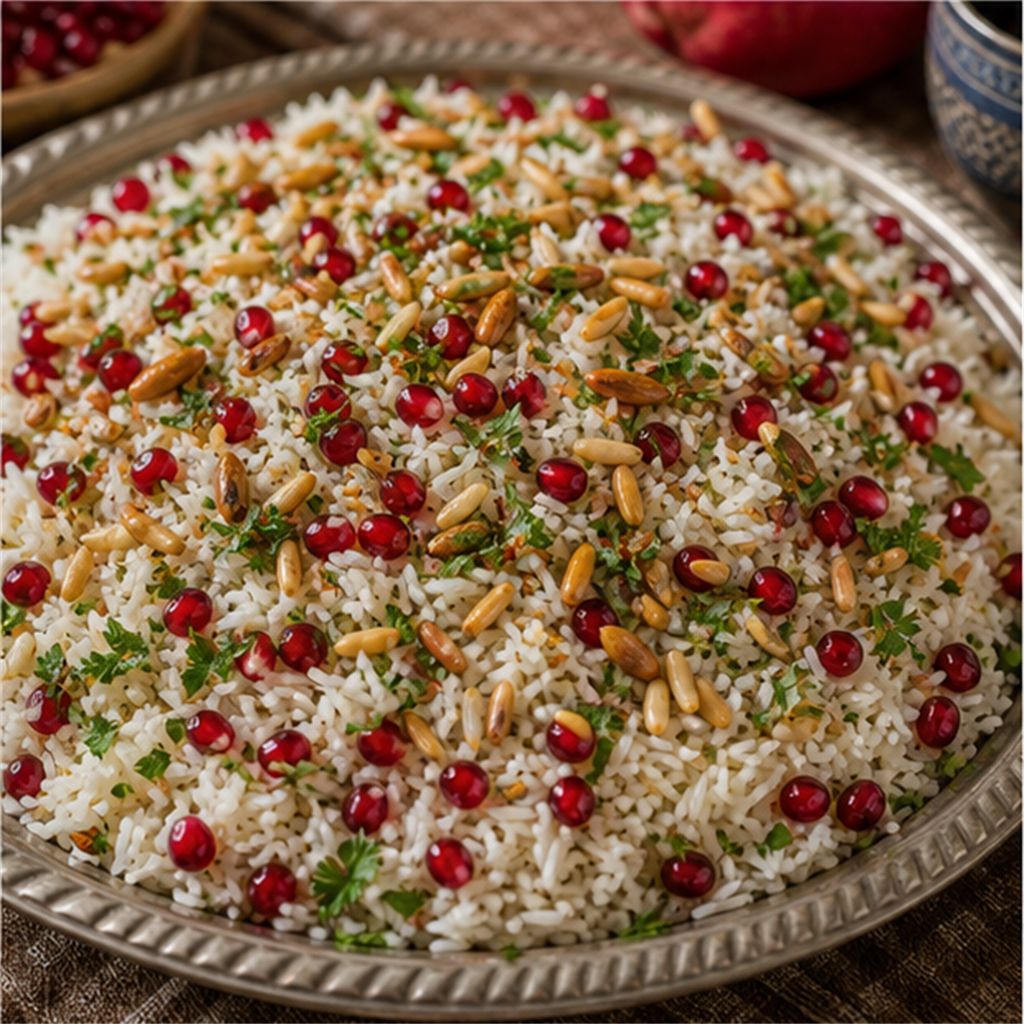
Lebanese Pomegranate Nut Rice
White basmati with measured ghee, pine nuts, almonds and fresh pomegranate.
Preparation: 20 min · Cooking: 20 min · Total: 45 min · 2 servings
Ingredients
- 100 g DRY white basmati rice
- 150 ml Ready-to-use hot vegetable stock
- 10 g RTE slivered almonds
- 30 g RTE fresh pomegranate arils
- 10 g RTE pine nuts
- 15 ml Ghee TOTAL for nuts and rice
- 0.125 tsp Ground cinnamon
- 0.125 tsp Ground allspice
- Salt, to taste
- 500 ml Potable rice-rinsing water, DISCARDED
- 60 ml Hot water MAXIMUM rice reserve (optional)
Instructions
Rinse and drain
Measure 100 g DRY white basmati, not parboiled or brown rice. Rinse in the 500 ml process allowance and discard rinse water; drain well. Check stock and nut labels/allergens.
Measure 100 g DRY white basmati, not parboiled or brown rice. Rinse in the 500 ml process allowance and discard rinse water; drain well. Check stock and nut labels/allergens.
Toast the nuts gently
Heat all 15 ml ghee gently in a fitted-lid rice pot; add 10 g pine nuts and 10 g almonds. Stir, checking from 3 minutes until light golden, not burnt. Lift nuts out with a slotted spoon; retain actual ghee in the pot.
Heat all 15 ml ghee gently in a fitted-lid rice pot; add 10 g pine nuts and 10 g almonds. Stir, checking from 3 minutes until light golden, not burnt. Lift nuts out with a slotted spoon; retain actual ghee in the pot.
Toast the nuts gently: 180 seconds
Coat the drained rice
Add drained rice to the actual remaining ghee and stir for about 2 minutes. Do not add unlisted oil or assume a fixed recovered-fat volume.
Add drained rice to the actual remaining ghee and stir for about 2 minutes. Do not add unlisted oil or assume a fixed recovered-fat volume.
Coat the drained rice: 120 seconds
Simmer with measured stock
Take pot off direct heat to carefully add 150 ml hot stock; add cinnamon, allspice and salt. Return to a boil, cover normally and simmer low from a 15-minute first check. Rice must be tender. Only if needed add the optional 60 ml MAX hot reserve gradually; incompatible rice/pot needs reconciliation, not unlimited water.
Take pot off direct heat to carefully add 150 ml hot stock; add cinnamon, allspice and salt. Return to a boil, cover normally and simmer low from a 15-minute first check. Rice must be tender. Only if needed add the optional 60 ml MAX hot reserve gradually; incompatible rice/pot needs reconciliation, not unlimited water.
Simmer with measured stock: 900 seconds
Rest off the stove
Remove pot from heat and rest covered 5 minutes. This rest does not replace checking that grains are fully tender; never multiply time or rice depth for larger batches.
Remove pot from heat and rest covered 5 minutes. This rest does not replace checking that grains are fully tender; never multiply time or rice depth for larger batches.
Rest off the stove: 300 seconds
Finish with all garnish
Fluff gently with a clean utensil suitable for the pot surface. Scatter all toasted nuts and 30 g washed/RTE arils over the rice just before serving. A metal fork is not required; do not scratch nonstick cookware.
Fluff gently with a clean utensil suitable for the pot surface. Scatter all toasted nuts and 30 g washed/RTE arils over the rice just before serving. A metal fork is not required; do not scratch nonstick cookware.
Check the scaled batch
The base is 2 catalogue shares: half uses 50 g dry rice/75 ml stock; fourfold 400 g/600 ml. Scale every input, including rinse and reserve, but use comparable-depth pots or batches rather than a deeper rice column.
The base is 2 catalogue shares: half uses 50 g dry rice/75 ml stock; fourfold 400 g/600 ml. Scale every input, including rinse and reserve, but use comparable-depth pots or batches rather than a deeper rice column.
Serve or chill promptly
Serve promptly, or portion rice with garnish into shallow containers and refrigerate quickly, ideally within 1 hour. Keep at 4°C or colder, use within 24 hours and reheat at most once to 74°C throughout. Never leave it to cool in the covered cooking pot.
Serve promptly, or portion rice with garnish into shallow containers and refrigerate quickly, ideally within 1 hour. Keep at 4°C or colder, use within 24 hours and reheat at most once to 74°C throughout. Never leave it to cool in the covered cooking pot.
Tips
- Step quantities describe 2 catalogue shares, not guaranteed dietary portions. Scale EVERY numeric input, process-water allowance and garnish by 0.5 for 1 share or 4 for 8 shares. Times, temperatures, thickness, oil depth and pan sizes do not multiply: use suitable comparable-depth vessels or successive base-size batches. Cup 240 ml, tbsp 15 ml, tsp 5 ml; product directions and actual allergens control.
Common mistakes
- Keep perishables at 4°C or colder. Separate raw meat, eggs and flour tools from ready-to-eat food. Refrigerate shallow portions promptly within 2 hours, or 1 hour above 32°C; do not wait for full counter cooling. These are refrigerator-entry deadlines, not a guaranteed cooling curve.
Substitutions
- Keep the specified raw/cooked/prepared states and amounts. Check actual labels and allergens; reconcile incompatible components rather than adding unmeasured ingredients. Never taste raw flour, dough, batter or sealing paste.
Storage
Rapidly cool in shallow portions, ideally refrigerating within 1 hour; keep at 4°C or colder for at most 24 hours. Reheat no more than once to 74°C throughout; unsafe earlier holding cannot be repaired by reheating. Keep perishables at 4°C or colder. Separate raw meat, eggs and flour tools from ready-to-eat food. Refrigerate shallow portions promptly within 2 hours, or 1 hour above 32°C; do not wait for full counter cooling. These are refrigerator-entry deadlines, not a guaranteed cooling curve.
Reheating
Reheat cooked leftovers only once to 74°C throughout, checking representative centres. A timer or browned surface is not enough; respect earlier component deadlines.
About this recipe
White basmati with measured ghee, pine nuts, almonds and fresh pomegranate.
Editorial approval does not establish independent kitchen testing. Check allergens and follow safe food handling.