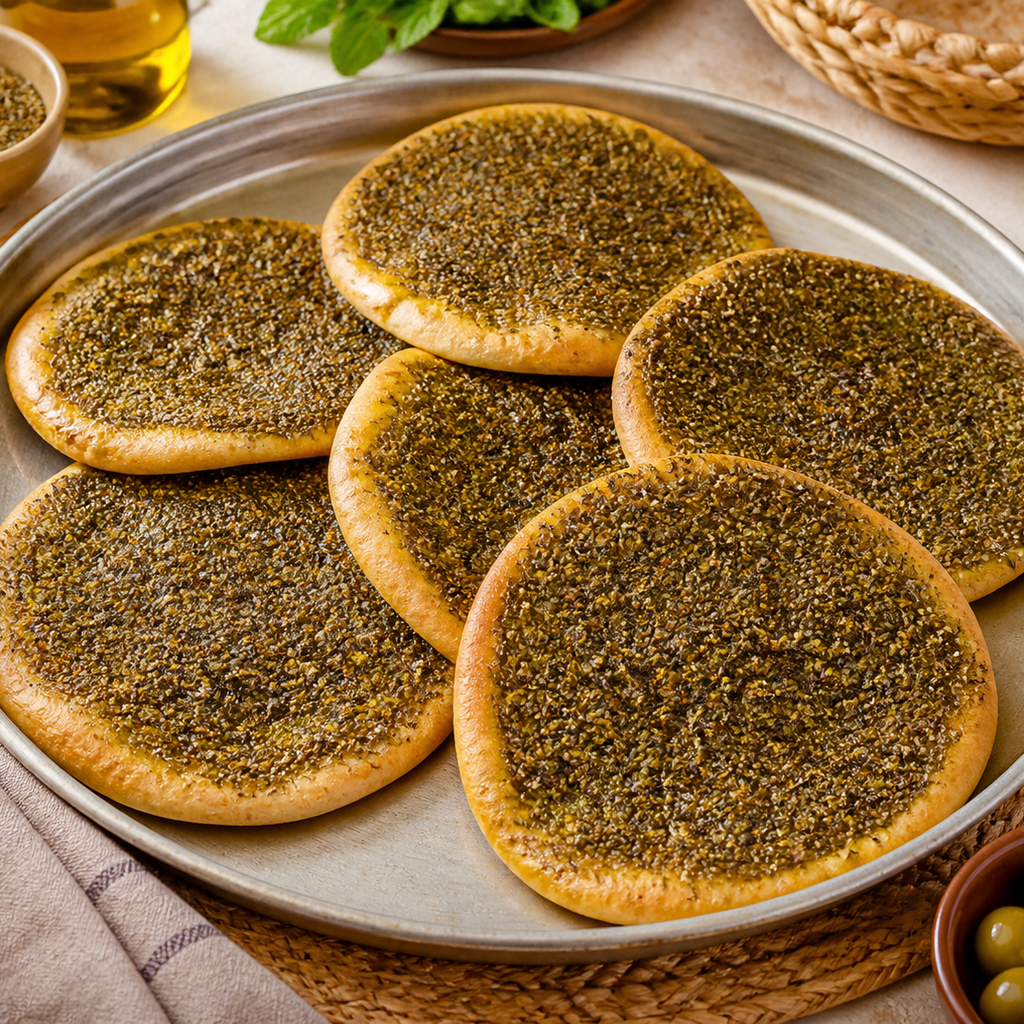
Jordanian Manakish Zaatar
Two thin flatbreads made from prepared risen dough with a measured zaatar topping.
Preparation: 30 min · Cooking: 8 min · Total: 39 min · 2 servings
Ingredients
- 5 ml Separate wheat flour for dusting only
- 45 ml Commercial zaatar blend with thyme, sesame and sumac
- 45 ml Olive oil
- 200 g READY-RISEN fresh yeasted wheat bread dough, prepared component
Instructions
Check prepared dough and oven
Use 200 g READY-RISEN fresh wheat bread dough, not 200 g dry flour. Check ingredient/allergen and cooking labels; reconcile any product incompatible with this method. Preheat to 220°C and use an oven-rated tray and any paper rated for 220°C. Reserve the separate 5 ml dusting flour; no extra yeast, water or sesame is included.
Use 200 g READY-RISEN fresh wheat bread dough, not 200 g dry flour. Check ingredient/allergen and cooking labels; reconcile any product incompatible with this method. Preheat to 220°C and use an oven-rated tray and any paper rated for 220°C. Reserve the separate 5 ml dusting flour; no extra yeast, water or sesame is included.
Mix all measured topping
Mix all 45 ml zaatar blend with all 45 ml olive oil, checking after about 1 minute until uniform. The timer is a mixing reminder, not a safety duration. Divide the ENTIRE paste equally across two breads; do not impose a fixed two-tablespoon finished-paste cap.
Mix all 45 ml zaatar blend with all 45 ml olive oil, checking after about 1 minute until uniform. The timer is a mixing reminder, not a safety duration. Divide the ENTIRE paste equally across two breads; do not impose a fixed two-tablespoon finished-paste cap.
Mix all measured topping: 60 seconds
Roll equal thin breads
Divide base dough into two 100 g portions and roll each to approximately 20 cm using only reserved dusting flour. Half makes one bread, fourfold eight on more matching trays, not thicker discs. Never taste raw dough.
Divide base dough into two 100 g portions and roll each to approximately 20 cm using only reserved dusting flour. Half makes one bread, fourfold eight on more matching trays, not thicker discs. Never taste raw dough.
Dimple without tearing
Dimple each disc gently with clean fingertips without puncturing. Keep about 1 cm rim free for the topping boundary.
Dimple each disc gently with clean fingertips without puncturing. Keep about 1 cm rim free for the topping boundary.
Spread the full topping
Spread half of the actual mixed paste on each base bread inside the 1 cm rim. Use all measured topping, with no unlisted oil or extra sesame garnish.
Spread half of the actual mixed paste on each base bread inside the 1 cm rim. Use all measured topping, with no unlisted oil or extra sesame garnish.
Bake hot on a suitable rack
Bake at 220°C on the lower rack if safe for the oven/tray, checking from 8 minutes. Follow stricter dough-label directions and continue until the base AND centre are fully baked with no raw gummy dough; time or topping colour alone is insufficient.
Bake at 220°C on the lower rack if safe for the oven/tray, checking from 8 minutes. Follow stricter dough-label directions and continue until the base AND centre are fully baked with no raw gummy dough; time or topping colour alone is insufficient.
Bake hot on a suitable rack: 480 seconds
Check and cool briefly
Cut a slightly cooled test section to check cooked dough. Continue baking if needed. Cool briefly before covering with a clean towel for softness; never put the towel in the oven or on a burner. Keep any further baking at 220°C.
Cut a slightly cooled test section to check cooked dough. Continue baking if needed. Cool briefly before covering with a clean towel for softness; never put the towel in the oven or on a burner. Keep any further baking at 220°C.
Serve and refrigerate leftovers
Serve two breads as 2 catalogue shares. Refrigerate leftovers promptly at 4°C or colder and use within 2 days or earlier component deadline. Reheat once to 74°C throughout; no pantry-preservation promise is made.
Serve two breads as 2 catalogue shares. Refrigerate leftovers promptly at 4°C or colder and use within 2 days or earlier component deadline. Reheat once to 74°C throughout; no pantry-preservation promise is made.
Tips
- The ingredient list scales for 1–8 catalogue servings; step quantities describe the 2-serving base. Halve every numeric input for 1 or multiply by four for 8, including process water, garnish and operating allowances. Do not multiply temperature, thickness or first-check time; use comparable-depth pans/batches. Piece yields are separate from servings. Cup = 240 ml, tbsp = 15 ml, tsp = 5 ml.
Common mistakes
- Keep perishables at 4°C or colder and raw meat/flour/egg tools separate from ready-to-eat food. Chill shallow portions promptly and refrigerate within 2 hours, or 1 hour above 32°C; do not wait for complete counter cooling.
Substitutions
- Keep the specified ingredient states and measured amounts; no unmeasured substitutions are included. Follow stricter package directions and reconcile incompatible products rather than forcing this calibration.
Storage
Keep covered at 4°C or colder and use within 2 days, or an earlier ingredient-label limit. This selected household limit is not validated shelf life. Keep perishables at 4°C or colder and raw meat/flour/egg tools separate from ready-to-eat food. Chill shallow portions promptly and refrigerate within 2 hours, or 1 hour above 32°C; do not wait for complete counter cooling.
Reheating
Reheat cooked leftovers once to 74°C throughout. Never use reheating to repair earlier unsafe holding.
About this recipe
Two thin flatbreads made from prepared risen dough with a measured zaatar topping.
Editorial approval does not establish independent kitchen testing. Check allergens and follow safe food handling.