Jordanian Makmoura
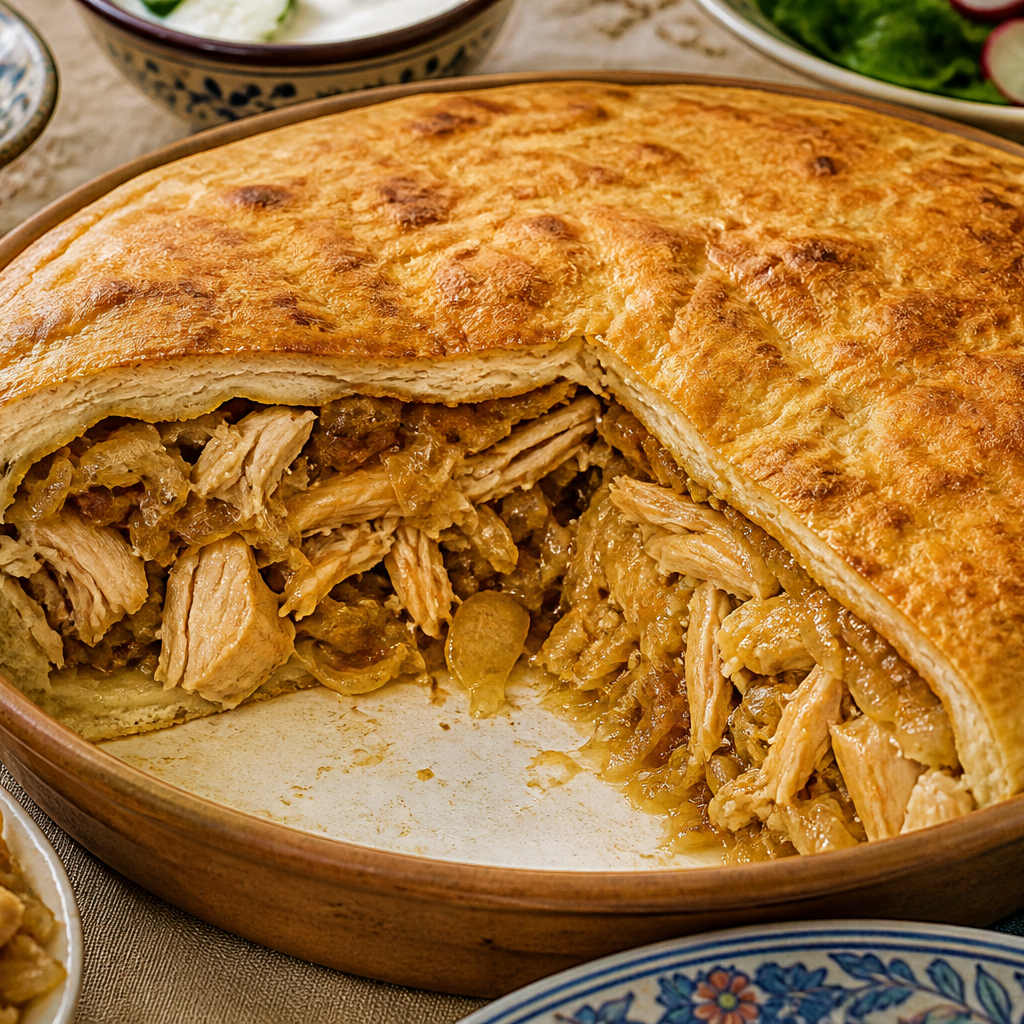
Six thin dough layers enclosing cooked chicken and onion in a comparable-depth pan.
Preparation: 30 min · Cooking: 2 hr 25 min · Total: 3 hr 25 min · 2 servings
Ingredients
- 200 g Raw boneless chicken thigh chunks
- 300 g Trimmed onion
- 70 ml Olive oil for onion and chicken
- 295 g Wheat flour for dough, from 300 g total
- 5 g Reserved wheat flour for dusting, from 300 g total
- 180 ml Dough water
- 0.5 tsp Fine salt for dough
- 10 ml Olive oil for pan coating
- 20 ml Olive oil for brushing layers
- 0.5 tsp Ground allspice
- 0.25 tsp Ground cumin
- 0.125 tsp Ground cinnamon
- 0.125 tsp Ground turmeric
- Filling salt, to taste
Instructions
Make and rest dough first
Reserve 5 g dusting flour separately; mix the remaining 295 g with 180 ml water and 0.5 tsp fine salt. Knead until smooth and rest covered from 30 minutes, then prepare filling so cooked chicken need not wait warm. Never taste raw dough.
Reserve 5 g dusting flour separately; mix the remaining 295 g with 180 ml water and 0.5 tsp fine salt. Knead until smooth and rest covered from 30 minutes, then prepare filling so cooked chicken need not wait warm. Never taste raw dough.
Make and rest dough first: 1800 seconds
Soften measured onion
Wash and slice 300 g trimmed onion. Heat the 70 ml sauté oil over medium-low heat and soften onion, checking from 15 minutes until translucent without scorching. The other 30 ml oil is reserved separately for coating and brushing.
Wash and slice 300 g trimmed onion. Heat the 70 ml sauté oil over medium-low heat and soften onion, checking from 15 minutes until translucent without scorching. The other 30 ml oil is reserved separately for coating and brushing.
Soften measured onion: 900 seconds
Cook chicken completely
Add 200 g raw boneless thigh chunks, 0.5 tsp allspice, 0.25 tsp cumin, 0.125 tsp each cinnamon and turmeric, and filling salt. Cook medium-low, checking from 10 minutes until chicken reaches 74°C with a clean thermometer; searing alone is insufficient. Keep cooked filling hot at 60°C or above if briefly coordinating assembly.
Add 200 g raw boneless thigh chunks, 0.5 tsp allspice, 0.25 tsp cumin, 0.125 tsp each cinnamon and turmeric, and filling salt. Cook medium-low, checking from 10 minutes until chicken reaches 74°C with a clean thermometer; searing alone is insufficient. Keep cooked filling hot at 60°C or above if briefly coordinating assembly.
Cook chicken completely: 600 seconds
Portion six thin discs per pan
Preheat to 180°C and coat an approximately 20 cm oven-rated metal pan with all 10 ml coating oil. Use one-third of actual dough for an oversized lining disc and divide the remaining two-thirds into five discs. Roll about 1–2 mm using only reserved 5 g flour. Half uses about 14 cm comparable-depth pan, still 6 discs; fourfold uses FOUR matching base pans and 24 discs, not one deep pan.
Preheat to 180°C and coat an approximately 20 cm oven-rated metal pan with all 10 ml coating oil. Use one-third of actual dough for an oversized lining disc and divide the remaining two-thirds into five discs. Roll about 1–2 mm using only reserved 5 g flour. Half uses about 14 cm comparable-depth pan, still 6 discs; fourfold uses FOUR matching base pans and 24 discs, not one deep pan.
Build five filling layers
Line the pan with the large disc and overhang. Divide actual cooked filling evenly into five layers alternating with the five remaining discs. Distribute the entire measured 20 ml brushing oil thinly across the dough layers; add no unlisted oil. Assemble promptly with clean tools.
Line the pan with the large disc and overhang. Divide actual cooked filling evenly into five layers alternating with the five remaining discs. Distribute the entire measured 20 ml brushing oil thinly across the dough layers; add no unlisted oil. Assemble promptly with clean tools.
Close and cover safely
Fold the outer overhang to close. Cover with oven-rated foil as suitable for the pan, without an unsafe pressure seal. Keep thickness and pan depth comparable when scaling, not fourfold thicker layers.
Fold the outer overhang to close. Cover with oven-rated foil as suitable for the pan, without an unsafe pressure seal. Keep thickness and pan depth comparable when scaling, not fourfold thicker layers.
Bake and check inner layers
Bake at 180°C, checking from 120 minutes. Continue until the centre reaches 74°C AND all inner dough layers are fully cooked, not raw or gummy; two hours is a first check, not a guarantee. Uncover only if needed for a cooked crust without scorching; protect from hot foil and steam.
Bake at 180°C, checking from 120 minutes. Continue until the centre reaches 74°C AND all inner dough layers are fully cooked, not raw or gummy; two hours is a first check, not a guarantee. Uncover only if needed for a cooked crust without scorching; protect from hot foil and steam.
Bake and check inner layers: 7200 seconds
Serve safely and chill
Let heat settle enough for controlled handling. Invert only if the vessel and platter are stable and manageable; otherwise serve wedges without a heavy flip. Divide into 2 catalogue shares. Chill shallow leftovers promptly at 4°C or colder, use within 2 days and reheat once to 74°C.
Let heat settle enough for controlled handling. Invert only if the vessel and platter are stable and manageable; otherwise serve wedges without a heavy flip. Divide into 2 catalogue shares. Chill shallow leftovers promptly at 4°C or colder, use within 2 days and reheat once to 74°C.
Tips
- The ingredient list scales for 1–8 catalogue servings; step quantities describe the 2-serving base. Halve every numeric input for 1 or multiply by four for 8, including process water, garnish and operating allowances. Do not multiply temperature, thickness or first-check time; use comparable-depth pans/batches. Piece yields are separate from servings. Cup = 240 ml, tbsp = 15 ml, tsp = 5 ml.
Common mistakes
- Keep perishables at 4°C or colder and raw meat/flour/egg tools separate from ready-to-eat food. Chill shallow portions promptly and refrigerate within 2 hours, or 1 hour above 32°C; do not wait for complete counter cooling.
Substitutions
- Keep the specified ingredient states and measured amounts; no unmeasured substitutions are included. Follow stricter package directions and reconcile incompatible products rather than forcing this calibration.
Storage
Keep covered at 4°C or colder and use within 2 days, or an earlier ingredient-label limit. This selected household limit is not validated shelf life. Keep perishables at 4°C or colder and raw meat/flour/egg tools separate from ready-to-eat food. Chill shallow portions promptly and refrigerate within 2 hours, or 1 hour above 32°C; do not wait for complete counter cooling.
Reheating
Reheat cooked leftovers once to 74°C throughout. Never use reheating to repair earlier unsafe holding.
About this recipe
Six thin dough layers enclosing cooked chicken and onion in a comparable-depth pan.
Editorial approval does not establish independent kitchen testing. Check allergens and follow safe food handling.