Kuih Ketayap
Malaysian pandan crêpes rolled around a moist gula melaka and coconut filling.
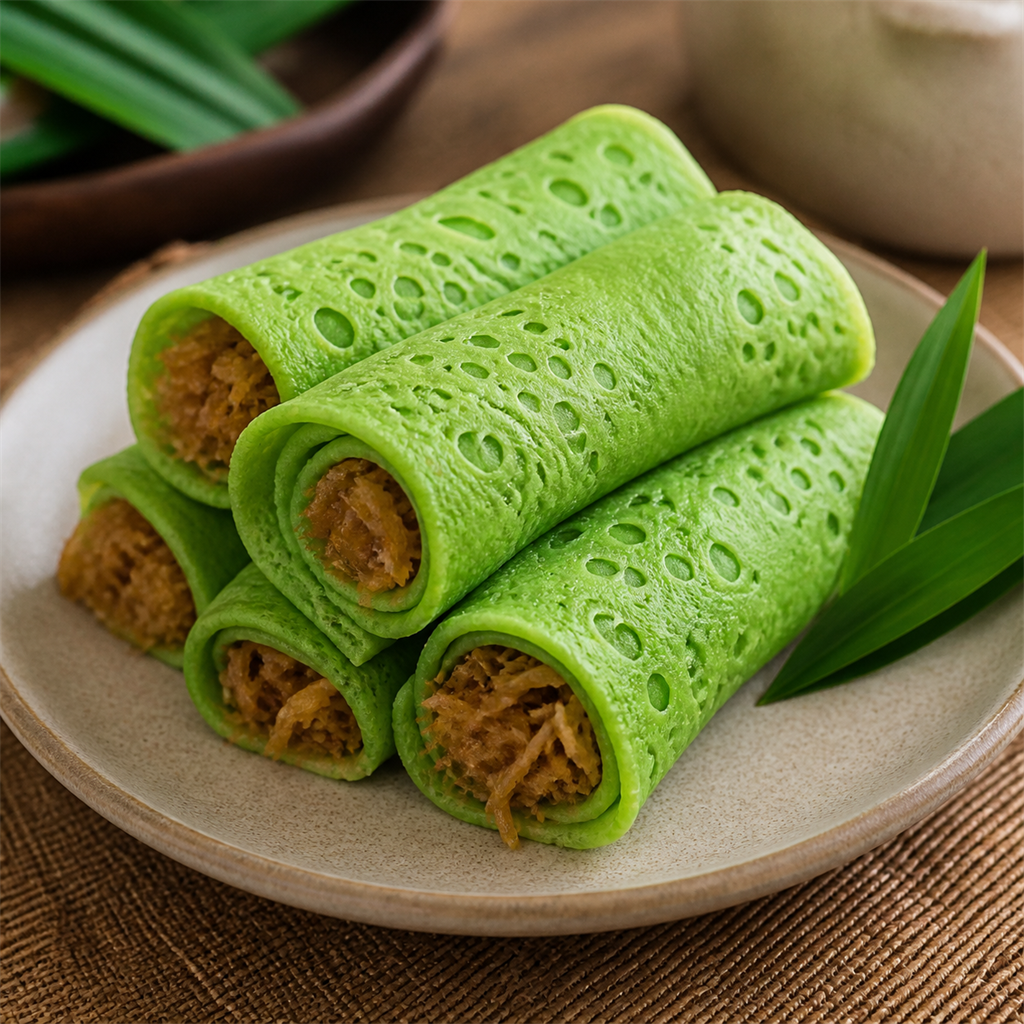
Preparation: 25 min · Cooking: 30 min · Total: 1 hr 15 min · 6 servings
Ingredients
- 30 g pandan leaves — washed; reserve 2 leaves for the filling
- 225 g all-purpose flour
- 200 g grated coconut — fresh or unsweetened desiccated
- 150 g gula melaka or palm sugar — finely chopped
- 2 pc large eggs — keep refrigerated
- 400 ml coconut milk — well shaken; keep refrigerated
- 375 ml water — 250 ml for pandan liquid and 125 ml for filling
- 0.5 tsp fine salt — divided
- 2 tbsp neutral oil — for the pan
Instructions
Organize and measure everything
Set out 30 g pandan leaves, 225 g all-purpose flour, 200 g grated coconut, 150 g gula melaka or palm sugar, 2 large eggs, 400 ml coconut milk, 375 ml water, 1/2 tsp fine salt, and 2 tbsp neutral oil. Wash the pandan leaves, finely chop the palm sugar, and keep the eggs and coconut milk refrigerated until needed. Use a blender, fine-mesh sieve, bowl, saucepan, 20 cm nonstick skillet, whisk, and flexible spatula.
Make the pandan crêpe batter
Reserve 2 pandan leaves for the filling. Cut the remaining leaves into 2 cm pieces, blend with 250 ml of the water until finely shredded, then strain through a fine-mesh sieve and press firmly; discard the fibrous pulp. Whisk the eggs, coconut milk, pandan liquid, and 1/4 tsp salt. Gradually whisk this liquid into the flour until smooth, strain once more, and rest for 20 minutes. The batter should pour like thin cream; whisk in 1 tbsp water only if it will not spread. After handling raw egg, wash hands, utensils, and splashed surfaces, and do not taste the raw batter.
Cook the coconut filling
Put the chopped palm sugar, remaining 125 ml water, reserved pandan leaves, and remaining 1/4 tsp salt in the saucepan. Stir over medium-low heat for 3–5 minutes until the sugar dissolves. Add the coconut and cook, stirring, for 8–10 minutes until evenly caramel-coloured and moist but with no free syrup in the pan. Remove the pandan leaves, transfer the filling to a shallow bowl, and cool completely. Melted palm sugar is extremely hot; stir with a utensil and do not touch or taste the filling until it has cooled.
Cook the crêpes
Whisk the rested batter. Heat the 20 cm nonstick skillet over medium-low heat and brush it very lightly with oil. Pour in about 60 ml batter and immediately tilt the pan to make a thin round. Cook for 60–90 seconds, until the top is matte, the edges lift, and no wet batter remains; turn for 10–15 seconds only if the second side still looks wet. Transfer to a plate and cover with a clean towel. Repeat, lightly oiling as needed, to make about 12 crêpes. Start the 30-minute timer as a batch reminder, but judge every crêpe by the visual cues. Keep the pan handle turned inward and away from children.
Each crêpe is thin and flexible, fully set with no wet batter; if checked, the egg batter reaches 71°C. The cooled filling is moist but does not leak syrup, and the rolls stay closed.
Cook the crêpe batch: 1800 seconds
Fill and roll the crêpes
Place one cooled crêpe with its smoother side down. Put about 2 tbsp cooled coconut filling in a short line near the lower third, leaving a 2 cm border. Fold the lower edge over the filling, fold both sides inward, and roll snugly into a parcel. Repeat with the remaining crêpes and filling. Do not roll while the filling is hot, because trapped syrup can burn and steam can tear the crêpes.
Check texture and doneness
Before serving, check that every crêpe is thin and flexible, with a fully set surface and no wet or floury centre; egg batter should reach 71°C if checked with a thermometer. The filling should hold together without leaking syrup, and each parcel should remain closed. If a crêpe is wet, return it to the pan in 15-second intervals. If the filling is loose, cook it briefly again and cool it before rolling. Do not rely on the timer alone.
Each crêpe is thin and flexible, fully set with no wet batter; if checked, the egg batter reaches 71°C. The cooled filling is moist but does not leak syrup, and the rolls stay closed.
Serve and store safely
Serve 2 rolls per person at room temperature, preferably the day they are made. The recipe contains wheat and egg; check the labels of coconut products when serving anyone with allergies. Refrigerate leftovers within 2 hours in a sealed container, separating layers with baking paper, for up to 2 days. Eat cold or reheat covered over low heat or by steaming until the centre reaches 74°C; discard rolls left at room temperature for more than 2 hours.
Tips
- Resting and straining the batter gives smoother, more flexible crêpes.
- Keep cooked crêpes covered so their edges stay supple for rolling.
Common mistakes
- A pan that is too hot browns the crêpes before the batter can spread thinly.
- Wet or hot filling leaks syrup and can tear the crêpes.
Substitutions
- If fresh pandan is unavailable, use 250 ml water plus pandan extract or paste at the label dosage; the flavour and colour will differ.
Storage
Refrigerate within 2 hours in a sealed container, with baking paper between layers, for up to 2 days.
Reheating
Eat cold, or reheat covered over low heat or by steaming until the centre reaches 74°C.
About this recipe
Kuih ketayap, also called kuih dadar or kuih lenggang, is a Malaysian rolled kuih: a pandan-scented green crêpe encloses coconut sweetened with gula melaka.
Editorial approval does not establish independent kitchen testing. Check allergens and follow safe food handling.