Käsespätzle
Fresh German egg noodles layered with melting mountain cheese and topped with crisp onions and chives.
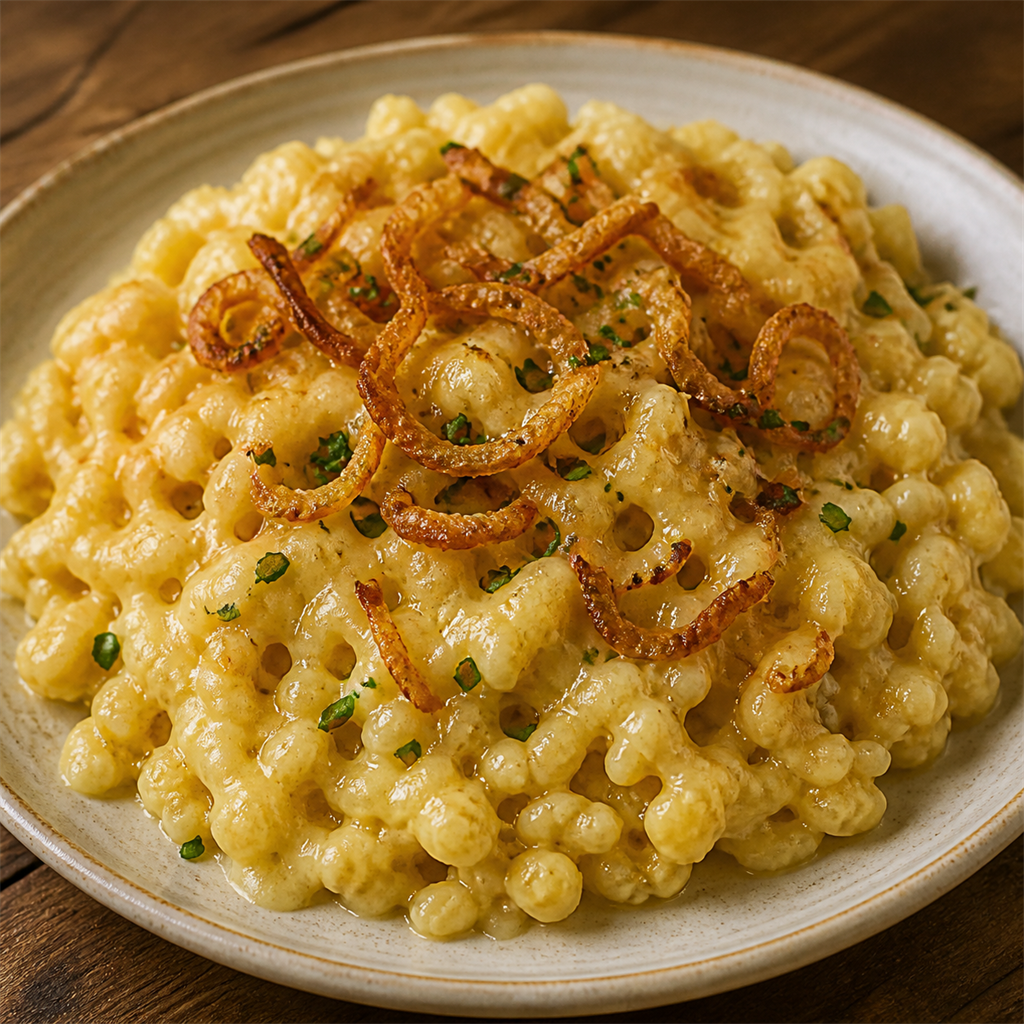
Preparation: 30 min · Cooking: 42 min · Total: 1 hr 20 min · 4 servings
Ingredients
- 400 g spätzle flour or all-purpose flour — Contains wheat.
- 300 g grated mountain cheese — Use Emmental, Bergkäse or a mixture; milk allergen.
- 400 g yellow onions — Peeled and thinly sliced.
- 50 g unsalted butter — Milk allergen.
- 15 g fresh chives — Finely cut.
- 4 large eggs — Keep refrigerated; egg allergen.
- 180 ml whole milk or water — Add gradually to reach the correct batter texture.
- 10 g fine salt — Divided between water and batter.
- 0.3 tsp ground nutmeg — Freshly grated if possible.
- 20 g all-purpose flour for onions — For coating the onions; contains wheat.
- 30 ml neutral cooking oil — Such as sunflower or rapeseed oil.
Instructions
Prepare ingredients and boiling water safely
Bring a large pot of water to a boil, then salt it with 5 g of the salt. Grate the cheese, thinly slice the onions and finely cut the chives. Keep eggs, milk and cheese refrigerated until needed. Wash hands and the work area after touching egg shells, and keep raw batter utensils away from cooked noodles and garnishes.
Beat and rest the spätzle batter
Combine the spätzle flour, remaining 5 g salt and nutmeg. Add the eggs and 150 ml milk or water. Beat vigorously with a wooden spoon for 5 minutes until the batter is smooth, elastic and forms large bubbles; it should fall from the spoon in thick ribbons. Add the remaining liquid 1 tablespoon at a time only if it is too stiff to press. Cover and rest 15 minutes, then beat briefly again.
Brown the onions until crisp
Toss the sliced onions with the 20 g flour, separating the rings. Heat the butter and oil in a large skillet over medium heat. Fry the onions for 10–12 minutes, stirring often, until deep golden and crisp but not black. Transfer them with a slotted spoon to a plate. Leave 1 tablespoon fat in the skillet and keep it over very low heat for the finished noodles.
Cook fresh spätzle with the retained timer
Start the retained 42-minute timer when onion frying begins; it covers browning the onions, boiling all noodle batches and melting the cheese. Press one quarter of the batter through a spätzle maker or large-holed colander directly into gently boiling water, keeping hands clear of steam. Stir once so the noodles separate. When they float, boil 2 minutes more, then remove with a clean slotted spoon and drain well. Check one: it should be tender and springy with no floury centre. Repeat with the remaining batter; do not crowd the pot and do not wait for the timer if each batch is ready.
Spätzle float and then boil 2 minutes, are tender and springy with no floury centre, reach at least 71°C, and are evenly coated with fully melted cheese.
Cook onions, spätzle and cheese: 2520 seconds
Layer hot noodles with cheese
Put one third of the hot drained spätzle into the warm skillet and cover with one third of the cheese. Repeat twice. Add 2–3 tablespoons hot cooking water around the edge, cover and heat on low for 4–5 minutes until the cheese is fully melted. Fold gently once or twice so long cheese strands coat the noodles without turning them into a paste.
Check noodle doneness and melt
Taste a noodle from the final batch: it must have no raw-flour centre, and the egg-based noodle mass should be at least 71°C. The cheese must be melted throughout and the mixture hot and cohesive, not watery. If a noodle is floury, boil that batch 1 minute more before layering. If the layered dish is below 71°C, cover and heat on low in 1-minute intervals.
Spätzle float and then boil 2 minutes, are tender and springy with no floury centre, reach at least 71°C, and are evenly coated with fully melted cheese.
Top, serve and store safely
Divide among four warm plates, top with the crisp onions and chives, and serve immediately. Refrigerate leftovers in shallow covered containers within 2 hours at 5°C or below and use within 3 days. Reheat once in a covered skillet with 1 tablespoon water per portion until the centre reaches 74°C; discard food held above 5°C for more than 2 hours.
Tips
- Beat until bubbles form; this develops the elastic texture that makes proper spätzle.
- Drain each batch well so the finished cheese coating stays creamy rather than watery.
Common mistakes
- A thin batter dissolves in the water; add liquid gradually.
- Crowding the pot cools the water and causes noodles to clump.
- Blackened onions taste bitter; remove them when deep golden.
Substitutions
- Use a mixture of Emmental and Gruyère if German Bergkäse is unavailable.
Storage
Refrigerate in shallow covered containers within 2 hours and use within 3 days.
Reheating
Reheat once, covered, with a little water until the centre reaches 74°C.
About this recipe
Käsespätzle is a comfort dish of southern Germany, especially Swabia and the Allgäu. Fresh egg noodles are layered with assertive melting cheese and traditionally finished with browned onions.
Editorial approval does not establish independent kitchen testing. Check allergens and follow safe food handling.