Jordanian Date Maamoul
Semolina-and-flour pastries with weighed date-paste centres and a refrigerated ghee rest.
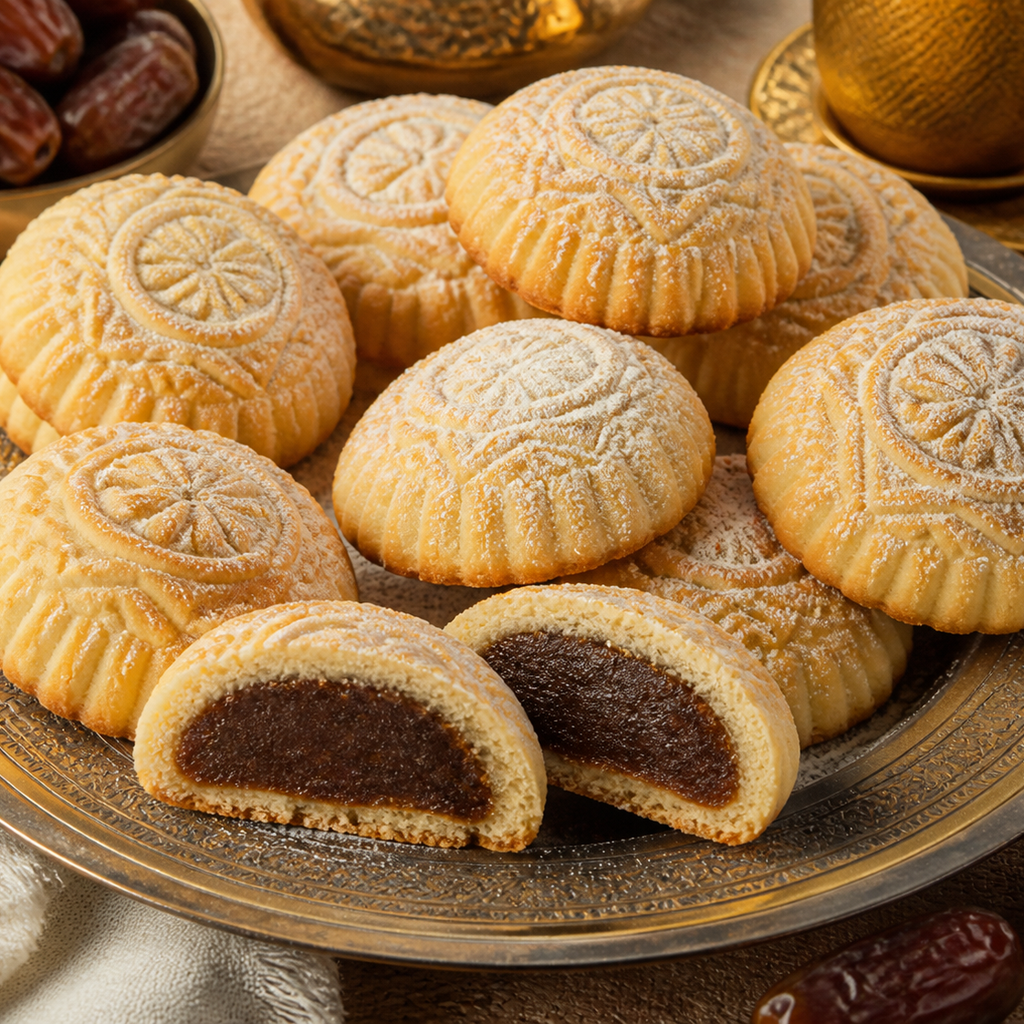
Preparation: 30 min · Cooking: 10 min · Total: 13 hr 10 min · 2 servings
Ingredients
- 200 g Fine semolina
- 250 g Commercial ready-to-eat pure date paste
- 0.125 tsp Ground mahlab
- 50 g Wheat flour
- 125 g Ghee, contains milk
- 45 ml Food-grade rosewater
- 0.5 tsp Instant yeast
- 30 ml Optional potable dough water, maximum; record actual use (optional)
- 15 g Powdered sugar for cooled pastries
Instructions
Rub grains with ghee
Gently melt 125 g ghee and let it become warm, not scalding. Rub into 200 g fine semolina and 50 g flour until evenly coated. Do not taste raw semolina/flour dough; ghee contains milk allergens.
Gently melt 125 g ghee and let it become warm, not scalding. Rub into 200 g fine semolina and 50 g flour until evenly coated. Do not taste raw semolina/flour dough; ghee contains milk allergens.
Rest refrigerated for 12 hours
Cover and refrigerate for 12 hours at 4°C or colder. This is fat-conditioning, not hydration from fat or a raw-flour safety treatment. Do not leave the mixture overnight on the counter.
Cover and refrigerate for 12 hours at 4°C or colder. This is fat-conditioning, not hydration from fat or a raw-flour safety treatment. Do not leave the mixture overnight on the counter.
Rest refrigerated for 12 hours: 43200 seconds
Add measured aromatics
Briefly soften the cold mixture enough to handle safely. Combine 45 ml rosewater with 0.5 tsp instant yeast and 0.125 tsp mahlab, following the yeast label for liquid warmth, then mix into the grains. Do not add unlisted orange-blossom water.
Briefly soften the cold mixture enough to handle safely. Combine 45 ml rosewater with 0.5 tsp instant yeast and 0.125 tsp mahlab, following the yeast label for liquid warmth, then mix into the grains. Do not add unlisted orange-blossom water.
Allow absorption and adjust sparingly
Cover and allow liquid absorption from 10 minutes, then knead gently just until cohesive. Only if needed add measured small increments from the up-to-30 ml potable water allowance and record actual use. No extra flour or rosewater is allowed.
Cover and allow liquid absorption from 10 minutes, then knead gently just until cohesive. Only if needed add measured small increments from the up-to-30 ml potable water allowance and record actual use. No extra flour or rosewater is allowed.
Allow absorption and adjust sparingly: 600 seconds
Weigh filling and shape
Divide the base dough evenly into 20 portions and the 250 g RTE date paste into EXACTLY 12.5 g per piece. Half makes 10 and fourfold 80 with the same filling weight and pastry thickness. Enclose and seal dates, then press with a clean dry food-safe mould; no dusting flour, sharp striking tool or fixed shell-to-filling size promise.
Divide the base dough evenly into 20 portions and the 250 g RTE date paste into EXACTLY 12.5 g per piece. Half makes 10 and fourfold 80 with the same filling weight and pastry thickness. Enclose and seal dates, then press with a clean dry food-safe mould; no dusting flour, sharp striking tool or fixed shell-to-filling size promise.
Bake from a 10-minute first check
Preheat the oven to 200°C. Space pastries on an oven-rated tray and bake at 200°C, checking from 10 minutes, not treating that time as proof of safety. Continue until the semolina/flour shell is fully cooked with a pale-golden base. A slightly cooled cut test must have no raw gummy shell; follow stricter product cooking directions. Use additional same-depth trays, not thicker pastries.
Preheat the oven to 200°C. Space pastries on an oven-rated tray and bake at 200°C, checking from 10 minutes, not treating that time as proof of safety. Continue until the semolina/flour shell is fully cooked with a pale-golden base. A slightly cooled cut test must have no raw gummy shell; follow stricter product cooking directions. Use additional same-depth trays, not thicker pastries.
Bake from a 10-minute first check: 600 seconds
Cool then finish
Cool pastries on a clean rack, checking from 20 minutes until safe to handle. Dust the cooled base batch with the measured 15 g powdered sugar; do not taste uncooked shells as a shortcut.
Cool pastries on a clean rack, checking from 20 minutes until safe to handle. Dust the cooled base batch with the measured 15 g powdered sugar; do not taste uncooked shells as a shortcut.
Cool then finish: 1200 seconds
Refrigerate filled pastries
Serve the 20-piece base as 2 catalogue shares. Refrigerate promptly at 4°C or colder within 2 hours, or 1 hour above 32°C, and use within 2 days. Do not claim weeks of room-temperature storage.
Serve the 20-piece base as 2 catalogue shares. Refrigerate promptly at 4°C or colder within 2 hours, or 1 hour above 32°C, and use within 2 days. Do not claim weeks of room-temperature storage.
Tips
- Use the scaled ingredient list for 1–8 catalogue servings; step quantities describe the 2-serving base. Halve every numeric input for 1 or multiply by four for 8, including process water and garnish. Keep the same thickness and use more batches or comparable-depth pans. Do not multiply temperatures or first-check times. Cup = 240 ml, tbsp = 15 ml, tsp = 5 ml. Piece/cup yields are separate from servings.
Common mistakes
- Keep perishables at 4°C or colder and raw meat/flour tools separate from ready-to-eat food. Chill shallow portions within 2 hours, or 1 hour above 32°C; do not wait for complete counter cooling.
Substitutions
- Keep the specified ingredient states and measured allowances; no unmeasured substitutions are included.
Storage
Keep covered at 4°C or colder and use within 2 days, never past an earlier label use-by date. This is a selected household limit, not validated shelf life. Keep perishables at 4°C or colder and raw meat/flour tools separate from ready-to-eat food. Chill shallow portions within 2 hours, or 1 hour above 32°C; do not wait for complete counter cooling.
Reheating
Reheat once to 74°C throughout; a warm surface alone is insufficient.
About this recipe
Semolina-and-flour pastries with weighed date-paste centres and a refrigerated ghee rest.
Editorial approval does not establish independent kitchen testing. Check allergens and follow safe food handling.