No-Soak Egyptian Rice
Short-grain rice toasted in measured ghee without soaking.
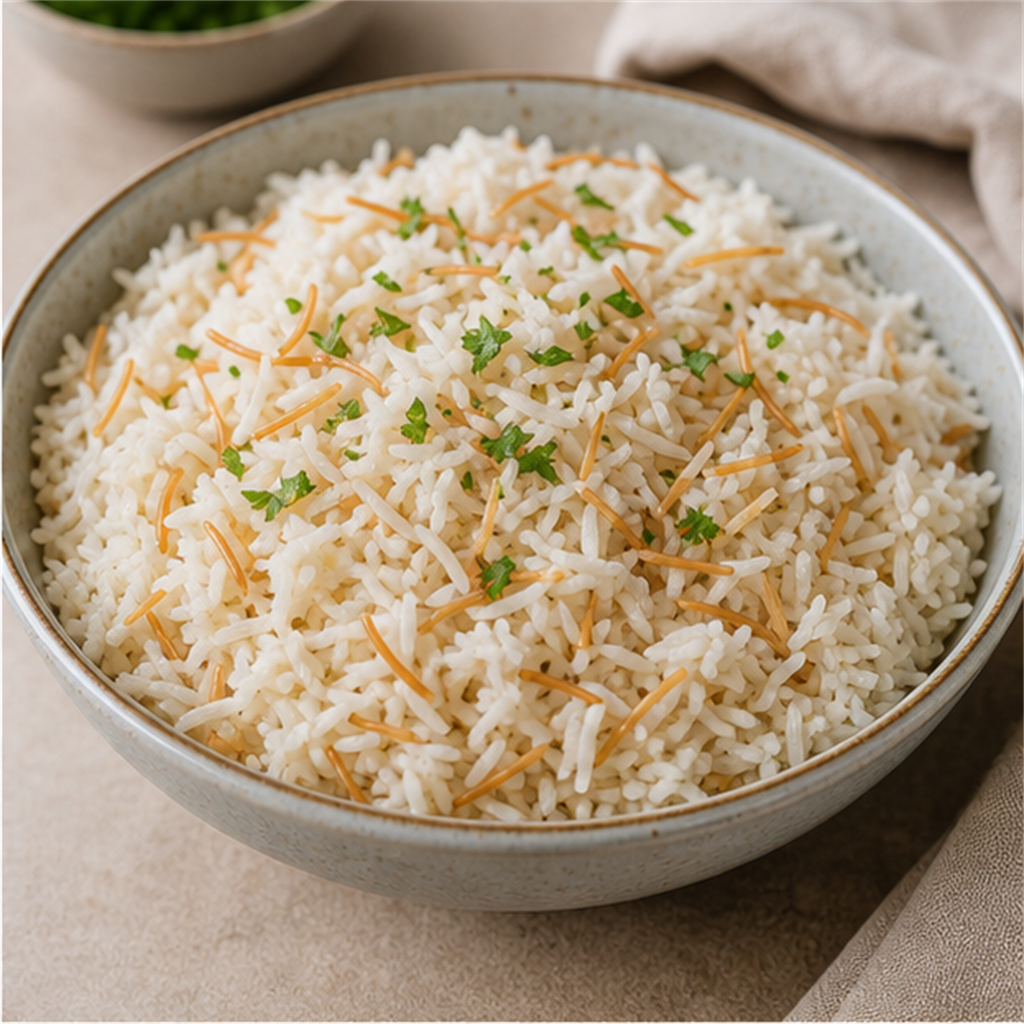
Preparation: 10 min · Cooking: 24 min · Total: 34 min · 4 servings
Ingredients
- 400 g dry short-grain Egyptian rice — Weigh dry before rinsing; do not soak.
- 35 g ghee — Measured for the base batch; use the scaled ingredient list for other yields.
- 1 tsp salt — Measured for the base batch; use the scaled ingredient list for other yields.
- 440 ml initial boiling cooking water — Measured for the base batch; use the scaled ingredient list for other yields.
- rice-rinsing water, discarded — Measured for the base batch; use the scaled ingredient list for other yields.
- boiling water only if needed — Conditional small additions only if rice dries while still firm; initial measured water remains 440 ml.
Instructions
Measure the explicit rice master
Measure 400 g rice dry, 440 ml initial boiling water, 35 g ghee and 1 tsp salt for 4 side portions. Fourfold is 1600 g rice, 1760 ml water, 140 g ghee and 4 tsp salt. Keep the specific 35 g ghee rather than the conflicting ratio’s 32 g.
Dry rice and initial liquid are measured separately.
Rinse without soaking
Rinse rice under cold running water until it runs clear, then drain thoroughly and briefly pat excess moisture away with a clean towel. Discard rinsing water. Do not soak or leave wet rice drying on the counter for hours.
Rice is well drained without soaking or prolonged counter drying.
Melt ghee over controlled heat
Melt all 35 g ghee in a heavy pot over controlled medium to medium-high heat. Have the measured boiling water ready; avoid smoking fat or a wet rice surface that would splash.
Ghee is melted without smoking.
Coat and toast the rice
Add the well-drained rice to the ghee and stir continuously for about 5 minutes until glossy and lightly toasted. Adjust heat to avoid scorching; do not add the old vermicelli or stock.
Grains are glossy and lightly toasted, not burnt.
Rice toasting check: 300 seconds
Add measured boiling water cautiously
Briefly take the pot off heat. Carefully add 440 ml boiling water and the measured salt, keeping hands and face away from steam. Return to heat and bring to a rolling boil for about 1 minute; this does not add a second unmeasured liquid allowance.
The measured liquid is added without scalding.
Initial rice boil: 60 seconds
Cover and simmer gently
Lower heat to a gentle simmer and cover with an ordinary lid. Check from about 15–18 minutes until grains are fully tender and separated, not by an exact universal timer. Do not use a pressure-sealed pot.
Rice is fully tender and the retained liquid is absorbed.
Rice tenderness check: 1080 seconds
Use conditional water only if needed
If the rice is drying while grains remain firm, add only a little conditional boiling water and continue covered over low heat until tender. Keep 440 ml as the initial measured water, not a promise that every rice or pot needs exactly that amount. Serve 4 side portions, or 16 from fourfold ingredients.
All sampled grains are tender; extra water is conditional only.
Chill rice promptly
Divide leftovers into shallow containers and refrigerate within 1 hour at 4°C or colder. Use within 24 hours; reheat a portion at most once to 74°C throughout.
Rice is promptly refrigerated in shallow portions.
Tips
- Scale ingredient amounts with the selected yield; cooking times are estimated checks, not multiplied guarantees.
Common mistakes
- Relying only on the timer or surface colour rather than the stated readiness and handling checks.
Substitutions
- Use the specified master ingredients. Prepared dough and spice blends are explicit compound ingredients; no unseen homemade subrecipes are assumed.
Storage
Divide leftovers into shallow containers and refrigerate within 1 hour at 4°C or colder. Use within 24 hours; reheat a portion at most once to 74°C throughout.
Reheating
Reheat only the portion needed, at most once, to 74°C throughout. Reheating does not repair previous unsafe holding.
About this recipe
This Egyptian owner-approved everyday rice master has no soaking or vermicelli and uses explicit initial water and conditional top-up instructions.
Editorial approval does not establish independent kitchen testing. Check allergens and follow safe food handling.