Crème brûlée
Vanilla custard with a crisp caramelized sugar top.
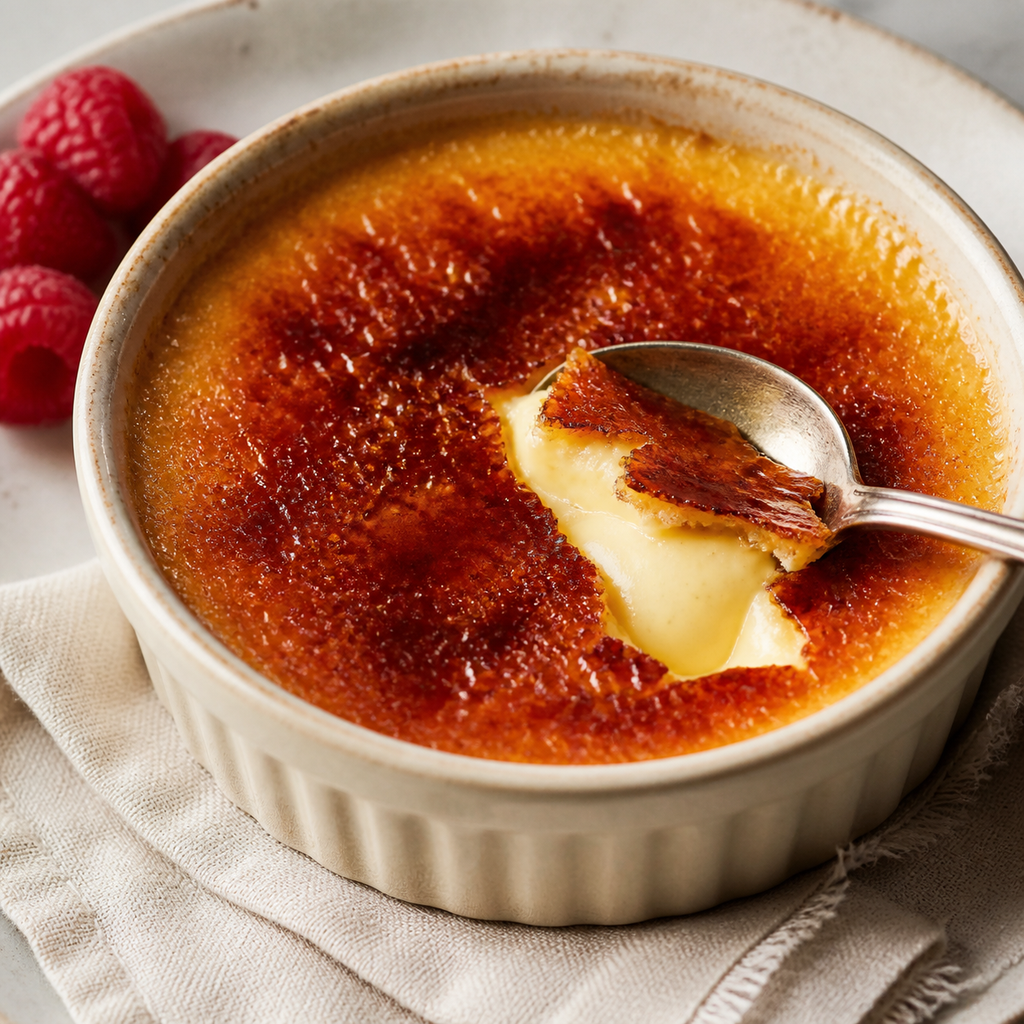
Preparation: 20 min · Cooking: 35 min · Total: 4 hr 30 min · 6 servings
Ingredients
- 500 ml heavy cream
- 5 pc egg yolks
- 90 g sugar
- 1 tsp vanilla
Instructions
Preheat the oven and arrange the ramekins
Set a rack in the lower-middle part of the oven and preheat to 150°C conventional (135°C fan). Place six dry 120–150 ml ramekins in a deep roasting pan, leaving a little space between them.
The oven is fully heated and all six ramekins sit level in the roasting pan.
Divide the sugar for custard and topping
Divide the total 90 g sugar into two bowls: 60 g for the custard and 30 g for the tops. Keep the 30 g portion dry and covered until the custards have chilled.
The sugar is clearly separated into 60 g and 30 g portions.
Warm the cream without boiling
Heat 500 ml heavy cream and 1 tsp vanilla over medium-low heat for 5–7 minutes. Take the pan off the heat when steam rises and small bubbles appear around the edge, before the surface boils.
The cream is steaming with small edge bubbles but is not boiling across the surface.
Check the warming cream: 300 seconds
Mix the yolks and custard sugar gently
Place 5 egg yolks in a heatproof bowl and add the 60 g sugar reserved for the custard. Stir with a hand whisk for about 30 seconds, until smooth and slightly lighter. Do not whip until foamy, because trapped bubbles mark the baked surface.
The yolk mixture is smooth and slightly paler with very little foam.
Temper the yolks with the hot cream
While stirring the yolks continuously, pour in about one-quarter of the hot cream in a thin stream. Once smooth, slowly stir in the remaining cream. Keep the whisk touching the liquid rather than lifting it, which limits foam.
The custard is smooth and fluid with no cooked egg flecks.
Strain and fill the ramekins evenly
Pour the custard through a fine sieve into a jug. Skim off any foam with a spoon, then divide the custard equally among the six ramekins. Each should be filled to the same depth so they finish together.
All six ramekins contain equal, smooth portions with almost no surface bubbles.
Build the hot water bath safely
Pull the oven rack partway out and set the roasting pan on it. Pour freshly boiled water into the pan—not into the custard—until the water reaches halfway up the outside of the ramekins. Slide the rack in slowly.
The water reaches halfway up each ramekin and none has splashed into the custard.
Bake until just set
Bake at 150°C conventional (135°C fan) and start the 30-minute timer. When it rings, nudge the roasting pan gently. The outer edge of each custard should be set while the center moves as one soft wobble. Check the center of each custard with a clean food thermometer; it must reach at least 71°C. If a center is still liquid or below 71°C, continue baking in 2-minute intervals and check again.
Set edges surround a center that wobbles as one piece but does not ripple; each center reaches at least 71°C.
Check the custards after 30 minutes: 1800 seconds
Cool, cover, and chill
With oven gloves, remove the roasting pan. Lift the ramekins out with jar tongs or a dry folded towel and place them on a rack. Cool for about 30 minutes, then cover each ramekin without touching the custard and refrigerate for at least 3 hours.
The custards are thoroughly cold and firm around the edges with a creamy center.
Chill the custards: 10800 seconds
Dry the surface and add a thin sugar layer
Uncover the cold custards and gently blot away any condensation with clean paper towel. Divide the reserved 30 g sugar evenly—about 5 g per ramekin—and tilt each ramekin until the sugar forms one thin, complete layer.
Every custard has a dry, even sugar layer with no bare patches or thick piles.
Caramelize the sugar and let it harden
Place one ramekin at a time on a heatproof surface. Hold a kitchen torch about 5–8 cm above the sugar and move the flame continuously in small circles until the entire surface melts and turns amber. Let the caramel harden for 2 minutes, then serve immediately.
The top is evenly amber, glassy, and hard enough to crack with a spoon.
Tips
- The center should wobble slightly when removed from the oven.
- Chill fully before adding the sugar top.
- Contains milk and eggs; check the vanilla label if managing other allergies.
Common mistakes
- Boiling custard makes it grainy.
- Too much sugar on top burns unevenly.
Substitutions
- Use orange zest for a citrus variation.
Storage
Refrigerate the covered custards at 4°C or below within 2 hours of baking; use within 2 days and caramelize just before serving.
Reheating
Do not reheat the custard; caramelize the cold top just before serving.
About this recipe
Crème brûlée is a French restaurant favorite built on simple custard technique.
Editorial approval does not establish independent kitchen testing. Check allergens and follow safe food handling.