Emirati Chicken Harees
Whole harees wheat and boneless chicken, slow-simmered and beaten smooth; six servings.
Preparation: 20 min · Cooking: 4 hr 20 min · Total: 12 hr 40 min · 6 servings
Ingredients
- 500 g whole harees wheat berries — Use whole harees wheat, not cracked wheat, bulgur or precooked matvete.
- 500 g boneless, skinless chicken thighs — The weight is boneless edible meat; do not substitute the same weight of bone-in chicken. Do not wash raw poultry.
- 3 tbsp ghee, melted, for serving (optional) — Optional: 3 tbsp, up to 4 tbsp to taste; fourfold 12, up to 16 tbsp. This is one topping allowance, not added again in the pot.
- 1.5 tsp salt
- 2500 ml fresh water for cooking — Start with 2500 ml for six servings; fourfold 10000 ml. Excludes discarded soaking water and the separate conditional reserve.
- 500 ml additional boiling water, maximum reserve if needed (optional) — Optional reserve ceiling, not an instruction to add it all: up to 500 ml per master / 2000 ml fourfold, in small increments only if needed.
- cold water for soaking, discarded — Enough to cover the wheat fully during refrigerated soaking; discard it before cooking.
- 1 pinch ground cinnamon, for serving (optional) — Optional pinch; scales to four pinches at 24 servings.
Instructions
Rinse and soak the whole wheat cold
Rinse the whole harees wheat under cold running water. Cover fully with separate cold soaking water in a large clean bowl, cover the bowl and refrigerate at 4°C or below for 6–8 hours or overnight. The eight-hour reminder is a check time, not a safety guarantee. Do not soak on the counter; cracked wheat, bulgur and precooked grains are not this master recipe.
Rinse and soak the whole wheat cold: 28800 seconds
Drain and prepare the chicken and water
Drain completely and discard all soaking water. Measure the fresh cooking water and keep the conditional reserve separate. Use the scaled ingredient-list quantity of boneless, skinless chicken thighs; do not wash raw poultry. Keep chicken refrigerated until needed and separate it from ready-to-eat food. Wash hands, utensils and surfaces after handling raw chicken.
Bring the pot to a boil
Place the drained wheat and raw chicken in a sufficiently large heavy-bottomed pot with 2500 ml fresh cooking water for six servings, or 10000 ml for 24. Bring to a rolling boil over high heat and skim the foam with a clean spoon. Leave ample headroom; the large batch needs a suitable pot and heat source, or divide into smaller pots.
Simmer gently and check the bottom
Stir in the salt, then reduce heat enough to maintain a gentle simmer, not merely a warm pot. Cover with a close-fitting ordinary lid, never an airtight seal or pressure lid. Simmer for 3–4 hours, opening occasionally to stir and check the bottom against scorching. If becoming dry, add boiling reserve water in small increments: up to 500 ml for six servings or 2000 ml for 24, only as needed. Do not add the entire reserve automatically; if the wheat is still firm, continue cooking and check liquid and texture. Cooking time is not automatically four times longer for the fourfold batch.
Simmer gently and check the bottom: 10800 seconds
Check temperature and grain tenderness
Before beating or blending, check several thick chicken centres and the porridge in several places with a clean food thermometer: each must reach at least 74°C (165°F). Wheat grains must have burst and become thoroughly soft with no hard centre, and chicken must shred easily. If either temperature or texture is not met, continue gently simmering and check again. Colour, clear juices and the three-hour reminder are not proof of safety.
Before beating or blending, check several thick chicken centres and the porridge in several places with a clean food thermometer: each must reach at least 74°C (165°F). Wheat grains must have burst and become thoroughly soft with no hard centre, and chicken must shred easily. If either temperature or texture is not met, continue gently simmering and check again. Colour, clear juices and the three-hour reminder are not proof of safety.
Inspect chicken and beat off the heat
Lift the fully cooked chicken onto a clean plate and inspect carefully for any accidental bone or cartilage fragments; discard any found before shredding and returning the meat. Remove the pot from the heat. Beat with a sturdy wooden harees paddle until the fibres break down into the wheat. Alternatively, use an immersion blender only if its manufacturer permits this hot, dense mixture; follow its temperature, fill and duty-cycle limits, keep the blade submerged and avoid splashes. Never blend bones or reach near a running blade.
Finish the texture and serve
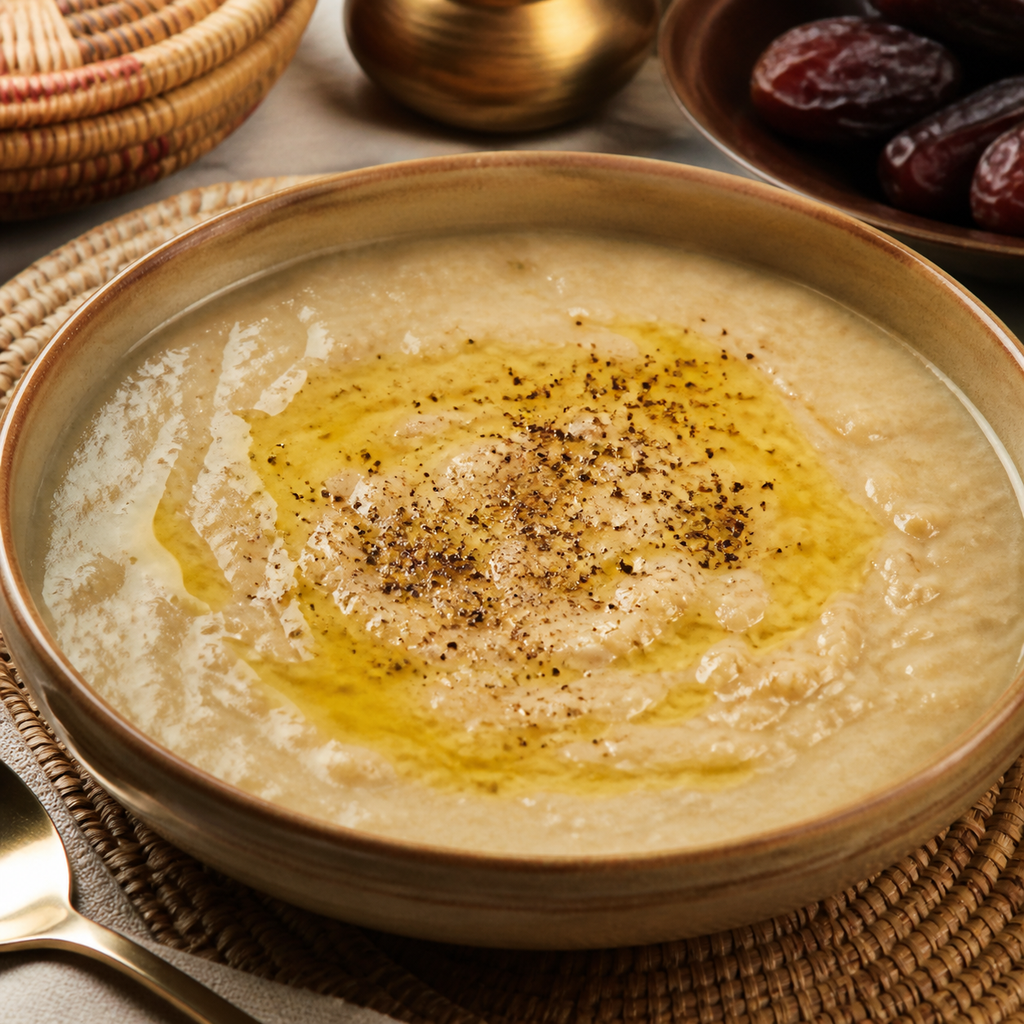
Check for a thick, smooth, elastic porridge without hard grains or distinct large meat pieces. Serve immediately in shallow serving dishes with a small well for the optional ghee; use 3 tbsp, up to 4 to taste for the master, or 12 tbsp, up to 16 for 24 servings. Optional cinnamon is a light dusting. This ghee is the single topping allowance, not an extra addition to the pot.
Check for a thick, smooth, elastic porridge without hard grains or distinct large meat pieces. Serve immediately in shallow serving dishes with a small well for the optional ghee; use 3 tbsp, up to 4 to taste for the master, or 12 tbsp, up to 16 for 24 servings. Optional cinnamon is a light dusting. This ghee is the single topping allowance, not an extra addition to the pot.
Cool promptly and reheat once
Divide cooked leftovers promptly into small, shallow containers and refrigerate within 1 hour of cooking at 4°C or below. Do not leave a large pot or deep stack to cool completely on the counter. Use refrigerated leftovers within 3 days, or freeze promptly. Reheat only the portion needed, stirring and adding a small splash of boiling water if necessary. Verify at least 74°C (165°F) throughout with a thermometer, reheat only once and discard reheated leftovers.
Tips
- Six servings: 500 g whole wheat + 500 g boneless chicken + 2500 ml cooking water, with up to 500 ml conditional reserve. At 24: 2000 g + 2000 g + 10000 ml, with up to 2000 ml reserve. Soaking water is separate and discarded.
- Optional ghee scales from 3 tbsp (up to 4) to 12 tbsp (up to 16). Optional cinnamon scales from one pinch to four. Fourfold salt is 6 tsp, equivalent to 2 tbsp.
- Total elapsed estimate 760 minutes includes an eight-hour cold soak, prep and cooking. Active work is about 60 minutes across the day; check the simmering pot periodically. Large pots take longer to boil and cool; do not multiply timers or leave cooking unattended.
Common mistakes
- Using cracked, bulgur or precooked wheat instead of the confirmed whole grain; replacing boneless chicken with the same bone-in weight.
- Adding soaking water or the entire reserve to the measured cooking liquid; sealing the pot airtight or leaving it to scorch.
- Blending before the thermometer and texture checks, or cooling leftovers in one deep pot.
Substitutions
- This master uses whole harees wheat and boneless, skinless chicken thighs; cracked or precooked grains and bone-in weights need a separately reviewed adaptation.
- Ghee and cinnamon are optional toppings and may be omitted. Wheat/gluten remains present; optional ghee adds milk. Do not claim allergen-free.
Storage
Divide dense cooked harees into small shallow containers and refrigerate within 1 hour at 4°C or below. Do not wait for the entire pot to cool completely. Use within 3 days or freeze promptly; this is conservative household guidance, not validated shelf-life certification.
Reheating
Reheat only the portion needed, stirring and loosening with a splash of boiling water. Check at least 74°C (165°F) throughout with a thermometer; reheat only once and discard reheated leftovers.
About this recipe
Harees is a traditional wheat-and-meat dish associated with Ramadan, hospitality and weddings. This Emirati chicken version uses slow cooking and beating to create a smooth, cohesive porridge.
Editorial approval does not establish independent kitchen testing. Check allergens and follow safe food handling.