Char Kway Teow
Malaysian flat rice noodles stir-fried in small batches with shrimp, egg, bean sprouts, chives, and savoury sauce.
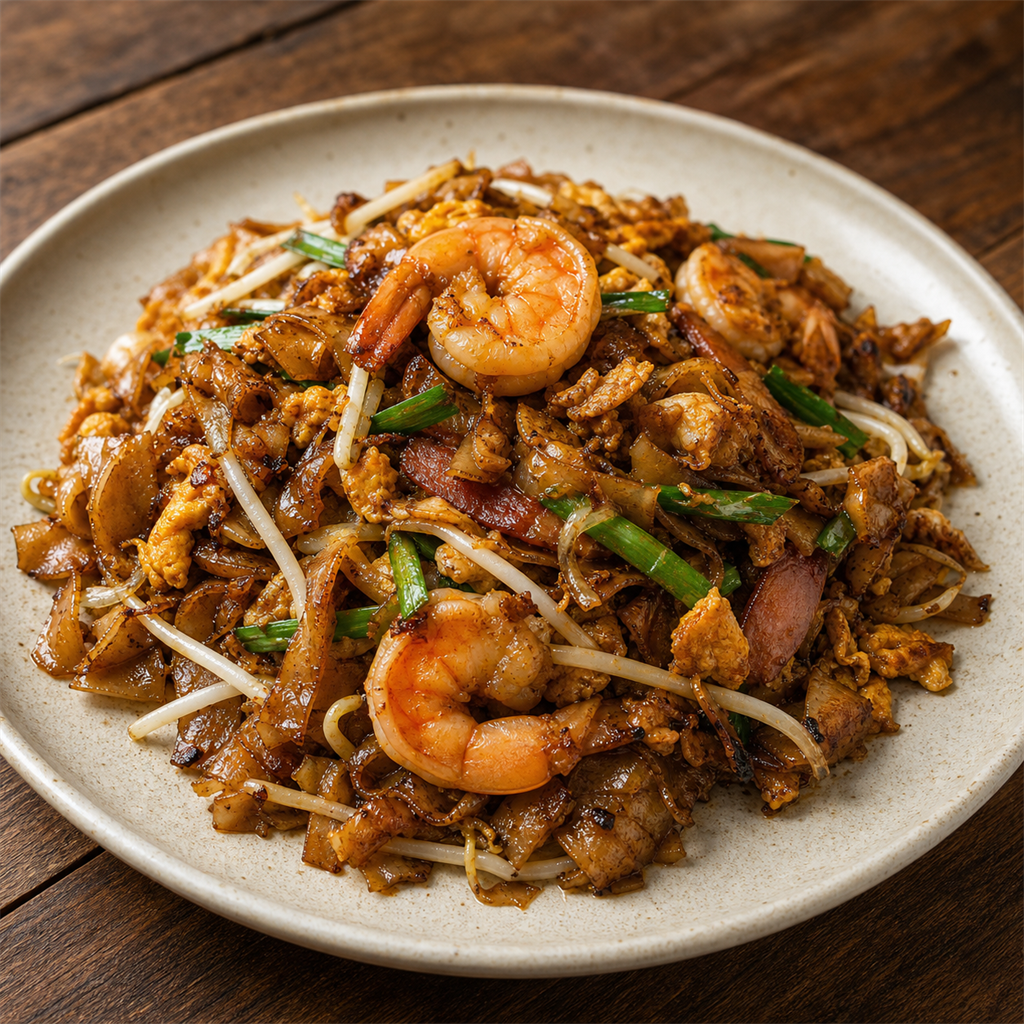
Preparation: 25 min · Cooking: 15 min · Total: 40 min · 4 servings
Ingredients
- 300 g dried wide flat rice noodles — or 600 g fresh refrigerated flat rice noodles
- 300 g raw peeled shrimp — deveined; thawed if frozen and kept refrigerated
- 2 tbsp light soy sauce
- 200 g bean sprouts — rinsed and thoroughly drained
- 3 pc large eggs — kept refrigerated
- 1 tbsp dark soy sauce
- 1 tbsp oyster sauce
- 1 tsp fish sauce
- 1 tbsp sambal oelek — reduce to taste for less heat
- 1 tsp granulated sugar
- 2 tbsp water — for the sauce
- 4 clove garlic — minced
- 100 g Chinese chives — cut into 5 cm lengths
- 3 tbsp neutral oil — high-smoke-point, divided
Instructions
Organize the ingredients and equipment
Set out 300 g dried wide flat rice noodles, 300 g raw peeled shrimp, 2 tbsp light soy sauce, 200 g bean sprouts, 3 large eggs, 1 tbsp dark soy sauce, 1 tbsp oyster sauce, 1 tsp fish sauce, 1 tbsp sambal oelek, 1 tsp sugar, 2 tbsp water, 4 garlic cloves, 100 g Chinese chives, and 3 tbsp neutral oil. Use a wok or large skillet, stove, colander, two bowls, tongs or a wok spatula, and an instant-read thermometer if available. Keep the shrimp and eggs refrigerated while preparing everything else.
Prepare the noodles and sauce
Prepare the noodles according to the package directions only until flexible but still chewy; do not fully soften them. Rinse briefly under cold water, drain thoroughly, and spread out for 10 minutes so surface water can evaporate. Whisk the light soy sauce, dark soy sauce, oyster sauce, fish sauce, sambal, sugar, and water in a bowl. If using fresh refrigerated rice noodles instead, loosen them gently according to the package directions and do not soak them.
Prepare the stir-fry components
Rinse and drain the bean sprouts. Mince the garlic and cut the Chinese chives into 5 cm lengths. Pat the shrimp dry with paper towel. Crack the eggs into a clean bowl and beat lightly. Divide the noodles, shrimp, sauce, sprouts, chives, and oil into two equal batches so the wok stays hot. Keep raw shrimp and its utensils away from the vegetables and cooked food; after handling it, wash hands, the board, knife, and any splashed surfaces with hot soapy water.
Stir-fry in two batches
Ventilate the kitchen. Heat the empty wok over high heat until very hot, then add half the oil. Add half the shrimp in one layer and stir-fry for 60–90 seconds until mostly opaque. Add half the garlic and stir for 15 seconds without letting it burn. Push everything to one side, add half the egg, and stir until softly set. Add half the noodles and half the sauce; toss vigorously for 1–2 minutes until the sauce is absorbed and the noodles are hot. Add half the sprouts and chives and toss for 30–60 seconds, until the sprouts are hot but crisp and the shrimp are pearly, opaque, and firm. Transfer to a clean platter, wipe away any burnt residue, and repeat with the second batch. The preserved 42-minute timer is an overall cooking-stage reminder, not a continuous cooking time; follow the short times and doneness cues for each batch.
Noodles are hot, separate, tender-chewy, and evenly coated; shrimp are pearly or white, opaque, and firm with no translucent centre; egg is fully set and reaches 71°C if measured; sprouts remain crisp.
Overall cooking-stage reminder: 2520 seconds
Finish and serve immediately
Combine the two cooked batches on the clean platter and toss once to distribute the ingredients. Taste one noodle with a clean utensil; add no more sauce until you have checked the salt level. Serve immediately in 4 warmed bowls while the noodles are glossy and the sprouts are still crisp. The dish contains crustacean shellfish, egg, soy, wheat in most soy and oyster sauces, fish, and oyster; verify every label for diners with allergies.
Check doneness and balance
Before serving, verify that the noodles are tender-chewy, separate, evenly coated, and not sitting in water or oil. The shrimp must be pearly or white, opaque, and firm throughout with no translucent centre. The egg must be fully set and should reach 71°C if measured. The sprouts should be hot but still crisp. If shrimp or egg are underdone, return the affected batch to the wok for 30-second intervals; do not rely on the timer alone.
Noodles are hot, separate, tender-chewy, and evenly coated; shrimp are pearly or white, opaque, and firm with no translucent centre; egg is fully set and reaches 71°C if measured; sprouts remain crisp.
Cool, store, and reheat safely
Refrigerate leftovers within 2 hours in a shallow sealed container and use within 2 days. Reheat only once in a hot wok or covered microwave, adding 1 tbsp water if needed, until every part reaches 74°C; discard leftovers that have stood at room temperature for more than 2 hours. High heat and oil can ignite: keep the wok handle inward, keep a lid nearby, never leave the wok unattended, and if oil burns turn off the heat and cover the wok—never use water.
Tips
- Divide every component before heating the wok so each batch moves quickly and the pan stays hot.
- Drain noodles and sprouts very well; surface water steams the dish and dilutes the sauce.
Common mistakes
- Over-soaked noodles break and turn sticky in the wok.
- Crowding the wok lowers its temperature, leaving wet noodles instead of a lightly charred stir-fry.
Substitutions
- For a pork-free home version, this recipe uses shrimp without the Chinese sausage found in some hawker versions; do not substitute tofu without separately validating its cooking and allergen guidance.
Storage
Refrigerate in a shallow sealed container within 2 hours and use within 2 days.
Reheating
Reheat once in a hot wok or covered microwave, adding 1 tbsp water if needed, until every part reaches 74°C.
About this recipe
Char kway teow is a Malaysian hawker-style stir-fry of flat rice noodles. High heat, fast tossing, savoury sauce, sprouts, chives, egg, and seafood create its characteristic smoky, glossy finish; versions vary by region and vendor.
Editorial approval does not establish independent kitchen testing. Check allergens and follow safe food handling.