Bolo de Rolo
A Pernambuco rolled cake made from many paper-thin butter-cake layers spread with guava paste.
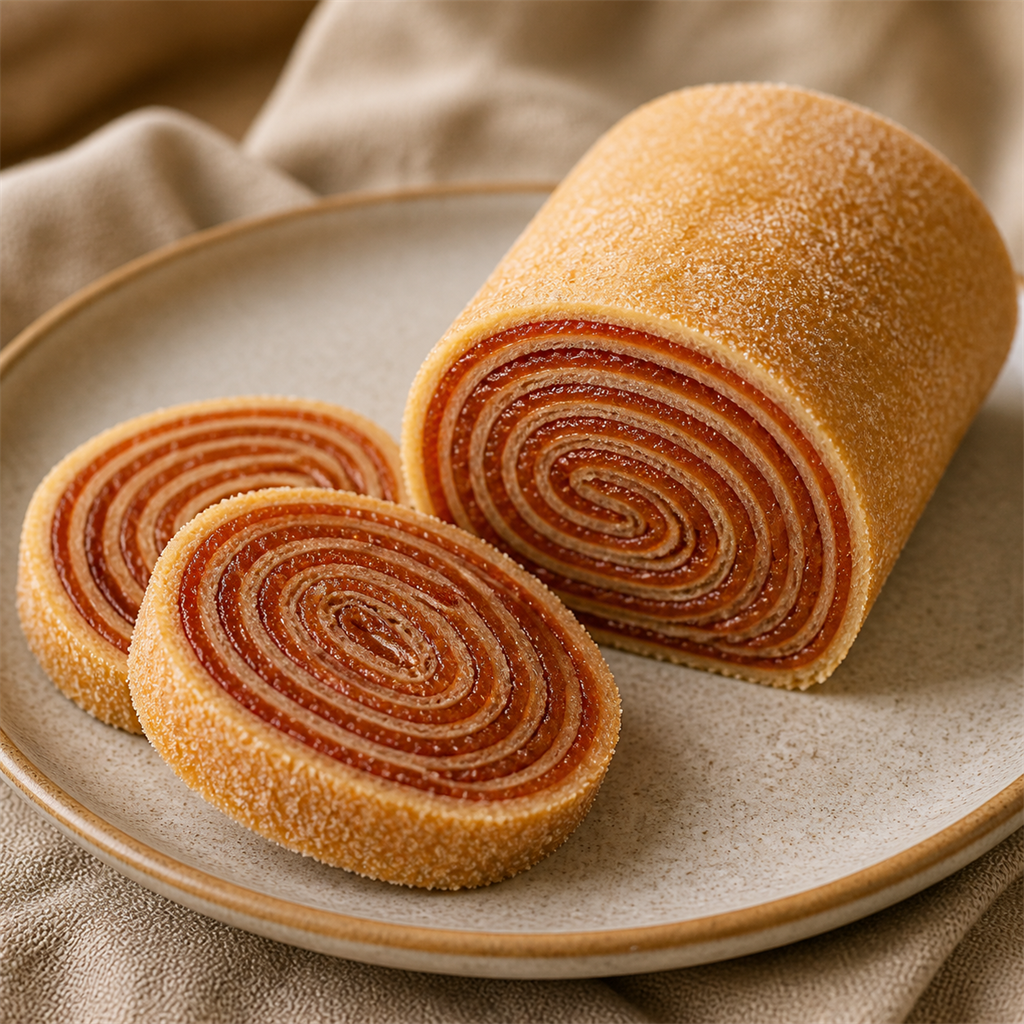
Preparation: 35 min · Cooking: 30 min · Total: 1 hr 45 min · 12 servings
Ingredients
- 250 g all-purpose flour — Sifted; contains wheat.
- 250 g unsalted butter — Softened but still cool; contains milk.
- 400 g guava paste — Cut into 2 cm cubes.
- 250 g caster sugar — Fine white sugar.
- 5 large eggs — Keep refrigerated; egg allergen.
- 120 ml water — For loosening the guava paste.
- 15 g icing sugar (optional) — Optional, for dusting.
Instructions
Prepare safely and heat the oven
Heat the oven to 180°C conventional or 160°C fan. Butter a 23 x 33 cm rimmed tray and line its base with baking paper; prepare five paper sheets cut to fit so the tray can be reused quickly. Bring the butter to cool room temperature. Keep the eggs refrigerated until needed, wash hands after touching shells and keep raw egg away from ready-to-eat filling.
Make the smooth guava filling
Cut the guava paste into 2 cm cubes and combine it with the water in a small saucepan. Heat over low to medium heat for 8–10 minutes, stirring and pressing the cubes, until completely smooth and spreadable like warm jam. If it becomes stiff, stir in 1 tablespoon hot water. Keep it warm over the lowest heat, stirring occasionally; hot guava can stick to skin and burn.
Mix the butter-cake batter
Beat the butter and caster sugar for 4–5 minutes until pale and fluffy. Add the eggs one at a time, beating until each disappears before adding the next and scraping the bowl. Sift in the flour in three additions and fold on low speed only until no dry streaks remain. Weigh or divide the batter into five equal portions so every baked layer is equally thin.
Bake the thin layers with the retained timer
Start the retained 30-minute timer when the first layer enters the oven. Spread one batter portion over a prepared paper sheet in the tray, right to the corners, in a very thin even layer about 2 mm thick. Bake each layer for 4–5 minutes until the surface is set, matte and lightly golden at the edges and the centre reaches at least 71°C; it must stay flexible, not brown and crisp. Lift out with its paper, immediately line the tray with the next sheet and repeat for all five portions. The total oven work is about 25–30 minutes; judge each layer rather than waiting for the timer to end.
Each 2 mm layer is set, matte, flexible and lightly golden at the edges, with no wet batter and a centre temperature of at least 71°C; the final roll has five tight spirals.
Bake all thin cake layers: 1800 seconds
Fill and roll the layers while warm
While the first layer is still warm, peel off the paper, spread with one fifth of the warm guava filling in a very thin layer and roll it tightly from a short edge without crushing it. Turn the next warm layer out, remove its paper and spread with another fifth of filling. Place the first roll along its short edge and roll the new layer around it. Repeat with the remaining warm layers and filling, keeping the seam underneath. Use the paper as a guide and protect your hands from the hot tray and sticky filling.
Check, shape and cool the roll
The finished roll should be compact, cylindrical and show five distinct tight spirals without raw or wet cake. If any unrolled layer is wet or below 71°C, return that layer to the oven for 1 minute before filling; never rebake the assembled roll. Wrap the warm roll snugly in clean baking paper for 10 minutes to hold its shape, then unwrap and cool completely on a rack for about 45 minutes.
Each 2 mm layer is set, matte, flexible and lightly golden at the edges, with no wet batter and a centre temperature of at least 71°C; the final roll has five tight spirals.
Finish, slice and store
Dust the cooled roll lightly with optional icing sugar. Trim only the uneven ends, then use a sharp serrated knife with a gentle sawing motion to cut 12 thin slices. Serve at room temperature. Store tightly wrapped in a cool room for up to 2 days or refrigerate for up to 5 days; let refrigerated slices stand for 20 minutes before serving. Do not reheat, because the guava filling can become dangerously hot and the cake can dry out.
Tips
- Weighing the batter into five portions makes the spiral even.
- Roll and join each layer while warm; cold layers crack instead of bending.
Common mistakes
- A thick layer becomes a Swiss roll rather than the characteristic fine spiral.
- Overbaking makes the cake crisp and impossible to roll.
- A thick or cold guava filling tears the delicate cake; keep it warm and spread it thinly.
Substitutions
- If firm guava paste is unavailable, use a thick guava spread and omit the water; it must not be runny.
Storage
Keep tightly wrapped in a cool room for 2 days or refrigerate for up to 5 days.
Reheating
Do not reheat. Bring refrigerated slices to room temperature for about 20 minutes.
About this recipe
Bolo de rolo is a culinary emblem of Pernambuco in northeastern Brazil. Unlike a single-layer Swiss roll, it is built by wrapping several exceptionally thin cake sheets with guava filling into a fine spiral.
Editorial approval does not establish independent kitchen testing. Check allergens and follow safe food handling.