Bitterballen
Dutch beef-ragout croquettes with a crisp breadcrumb shell, served hot with mustard.
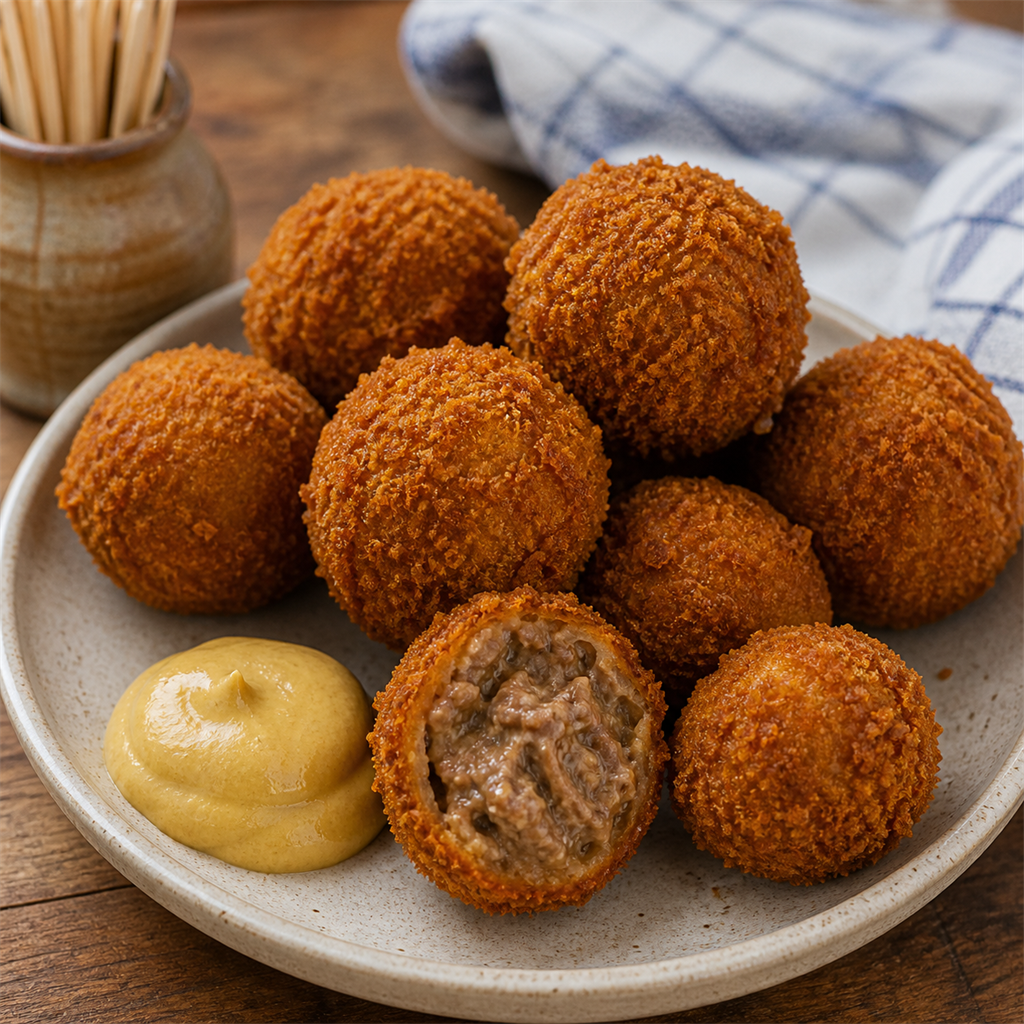
Preparation: 35 min · Cooking: 35 min · Total: 5 hr 30 min · 4 servings
Ingredients
- 300 g cooked beef, finely shredded — Use chilled braised or boiled beef; remove gristle and large fat pieces.
- 400 ml low-salt beef broth
- 60 g unsalted butter
- 200 g fine dry breadcrumbs
- 30 ml Dutch mustard, for serving
- 140 g plain wheat flour — Use 80 g in the roux and 60 g for coating.
- 100 g yellow onion, finely diced
- 15 g flat-leaf parsley, finely chopped
- 1 g ground nutmeg
- 2 pc large eggs — For coating; keep refrigerated until use.
- 1.5 l neutral frying oil — Use enough for 6–8 cm depth while keeping the pan no more than half full.
- 3 g fine salt
- 1 g ground black pepper
Instructions
Prepare the ingredients and cooling dish
Finely shred or chop the cooked beef, dice the onion to about 3 mm, and chop the parsley. Measure 80 g of the flour for the roux and reserve 60 g for coating. Set a shallow dish near the stove. Keep the cooked beef refrigerated until it is added.
Cook a thick roux-based ragout
Melt the butter in a saucepan over medium-low heat. Cook the onion for about 5 minutes until soft but not browned. Stir in the 80 g roux portion of flour and cook for 2 minutes. Add the broth gradually while whisking. Simmer for 6–8 minutes, stirring firmly along the bottom, until the ragout is very thick and pulls away from the pan.
Add the beef and chill the filling
Stir in the cooked beef, parsley, nutmeg, salt, and pepper. Cook for 3–4 minutes until evenly steaming and at least 74°C. Spread the ragout in the shallow dish, cover its surface, cool for no longer than 1 hour at room temperature, then refrigerate for at least 4 hours until cold and firm.
Shape, double-coat, and firm the balls
Divide the cold ragout into 24 portions and roll into balls about 3–4 cm wide. Beat the eggs in one bowl; place the reserved flour and breadcrumbs in separate bowls. Coat each ball in flour, egg, breadcrumbs, egg again, and a final layer of breadcrumbs. Refrigerate and start the preserved 22-minute timer; the coating should feel firm before frying.
Firm the breaded bitterballen: 1320 seconds
Heat the oil and fry in batches
Pour the oil into a deep, heavy pan no more than halfway full and heat it to 175°C. Fry 4–6 balls at a time for 3–4 minutes, turning as needed, until deep golden. Let the oil return to 175°C between batches. Lower the balls carefully with a slotted spoon so they do not splash.
Check the crust and centre
A finished bitterbal has an even, crisp, deep-golden shell and a piping-hot centre. Check one ball from the first batch: the filling should reach at least 74°C. If the coating splits, stop and chill the remaining balls longer; if the centre is cool, fry subsequent batches slightly longer without exceeding 180°C oil.
The shell is evenly crisp and deep golden, and the centre is piping hot and at least 74°C.
Drain, serve, and store safely
Lift the bitterballen onto a rack set over a tray and rest for 3 minutes; the filling is extremely hot. Serve 6 per portion with mustard. Refrigerate cooked leftovers within 2 hours and use within 2 days, or freeze uncooked coated balls for up to 2 months.
Tips
- Use one hand for flour and breadcrumbs and the other for egg so the coating stays even.
Common mistakes
- Warm ragout cannot hold a ball shape and may split in the oil.
- Crowding the pan drops the oil temperature and makes the crust greasy.
Substitutions
- Use veal or a mixture of beef and veal in the same cooked weight; use a labelled gluten-free flour and breadcrumb system when required.
Storage
Refrigerate cooked bitterballen within 2 hours and use within 2 days. Freeze uncooked coated balls in a single layer, then bag for up to 2 months.
Reheating
Reheat cooked bitterballen at 200°C for 8–12 minutes until crisp and 74°C in the centre; do not deep-fry them again.
About this recipe
Bitterballen is a Dutch pub snack served hot with mustard for dipping from Netherlands.
Editorial approval does not establish independent kitchen testing. Check allergens and follow safe food handling.