Omani Lamb Biryani
Layered white basmati with tender bone-in lamb, measured recovered broth and saffron.
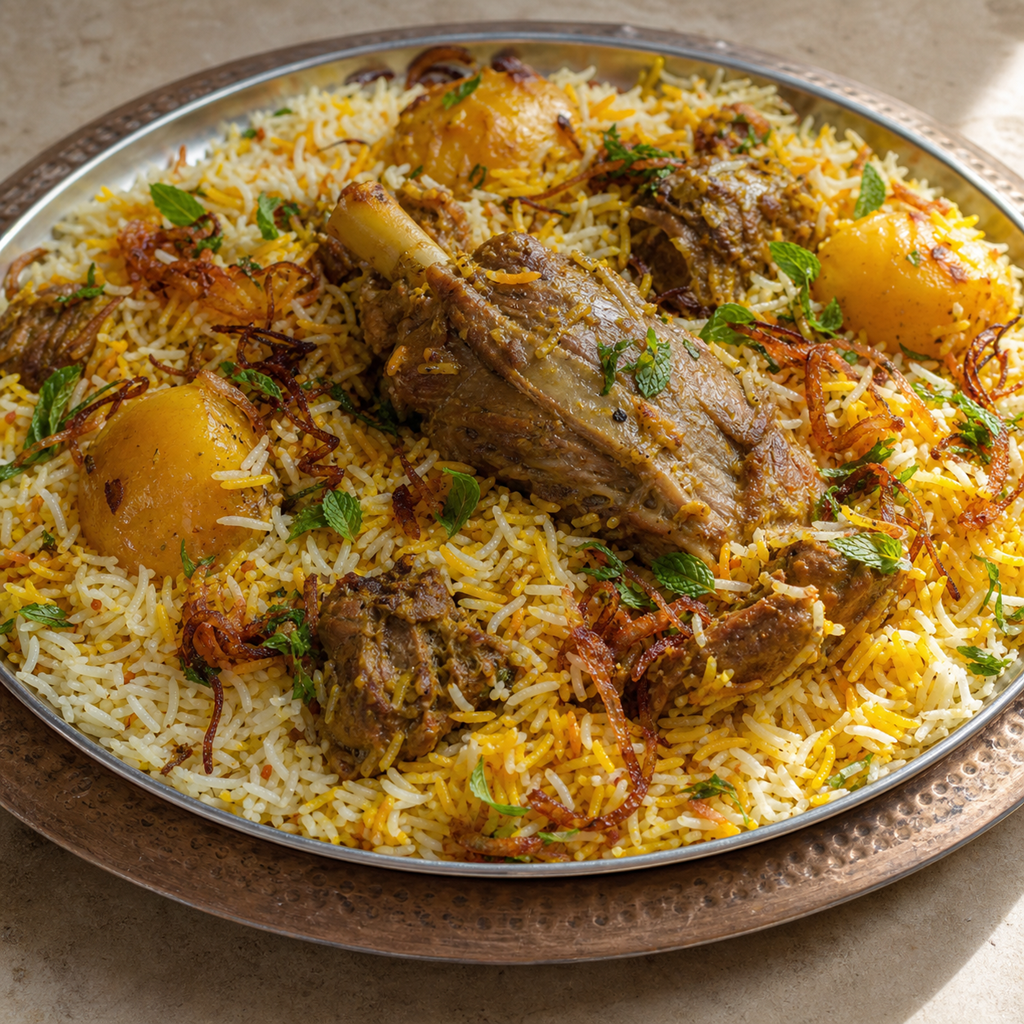
Preparation: 25 min · Cooking: 1 hr 30 min · Total: 2 hr 15 min · 2 servings
Ingredients
- 300 g Dry white basmati rice
- 360 g RAW bone-in lamb shoulder pieces
- 45 ml Pasteurized plain yogurt
- 0.125 tsp Dry saffron threads
- 150 g Raw yellow onion
- 30 ml Neutral oil, 20 ml onion / 10 ml meat base
- 30 ml Warm water for saffron infusion
- 0.5 tsp Salt for meat
- 1000 ml Rice rinse/soak water, discarded
- 2000 ml Separate rice-parboiling water, drained
- 1 tsp Salt for discarded parboiling water
- 1000 ml Initial meat-braising water
- 500 ml Hot water, maximum braising/broth top-up reserve (optional)
- 180 ml RECOVERED hot strained meat broth for steaming, not additional water
- Cinnamon-stick piece, about 3 cm — 1
- Whole cloves — 3
- 0.5 tsp Commercial unsalted Omani Bezar spice blend
- 0.125 tsp Ground cardamom
Instructions
Soak rice and bloom saffron
Rinse rice in its measured rinse/soak water. Soak covered in the refrigerator at 4°C or colder for 20 minutes. Drain and discard that water. Bloom saffron in ONLY the separately measured infusion liquid. Prepare normal fitted lids, a sieve, clean thermometer and hot-holding arrangements; never use cloth seals.
Prepare normal fitted lids, a sieve, clean thermometer and hot-holding arrangements; never use cloth seals.
Refrigerated rice soak: 1200 seconds
Brown onion in its oil share
Thinly slice the onion. Cook in TWO-THIRDS of the oil over medium heat, first check after 8 minutes, until golden, not black. Remove with a suitable utensil; no recovered onion/oil yield is assumed. Keep cooked onion protected from raw meat tools. Reserve the remaining ONE-THIRD of oil for the meat base.
Reserve the remaining ONE-THIRD of oil for the meat base.
Onion browning first check: 480 seconds
Start the lamb braise
Place lamb in a deep heavy pot with initial braising water, cinnamon, cloves and meat salt. Bring to a boil, then simmer gently with a normal fitted lid. Use the bounded hot-water reserve only if needed to maintain coverage. Never multiply the size or depth of the base pot for a fourfold batch.
Never multiply the size or depth of the base pot for a fourfold batch.
Check lamb temperature and tenderness
First check the lamb after 50 minutes and continue until fork-tender. Probe thick meat away from bone: at least 63°C with a 3-minute rest is the whole-cut minimum; tenderness may require longer. Keep cooked meat/broth at 60°C or above while coordinating rice, or chill safely if preparing ahead.
Keep cooked meat/broth at 60°C or above while coordinating rice, or chill safely if preparing ahead.
Lamb braising first check: 3000 seconds
Minimum whole-lamb rest: 180 seconds
Measure broth and parboil rice
Lift cooked lamb onto a clean hot plate; strain broth and discard cinnamon/cloves. Measure ONLY the listed recovered broth for steaming; if short, top up only from the shared reserve, not an extra unlisted water input. Keep hot; surplus broth stays separate. Parboil drained rice in its SEPARATE fresh salted water, first check after 7 minutes, until mostly cooked with a firm centre; drain immediately.
Parboil drained rice in its SEPARATE fresh salted water, first check after 7 minutes, until mostly cooked with a firm centre; drain immediately.
Rice parboiling first check: 420 seconds
Build the lamb and rice layers
Warm lamb, yogurt and Bezar in the reserved ONE-THIRD of oil in a heavy base-size pot; cook the yogurt mixture through. Layer drained rice over the lamb and top with cooked onion and ground cardamom. Add ONLY the measured recovered broth and saffron-water infusion: base 180 + 30 = 210 ml total steam liquid. Normal fitted lid, lowest stable heat; first check after 20 minutes. No towel, extra oil or all-broth pour.
No towel, extra oil or all-broth pour.
Layered rice steaming first check: 1200 seconds
Check and rest off heat
Require tender rice without a chalky centre and 74°C throughout the final assembled meat-and-rice dish; check the thickest meat and centre away from bone. Continue as needed, then rest covered OFF heat for 5 minutes and fluff gently. For 4×, steam in comparable-depth base-size batches; liquid is 720 + 120 = 840 ml in total across the batches, not an unlimited depth rule.
For 4×, steam in comparable-depth base-size batches; liquid is 720 + 120 = 840 ml in total across the batches, not an unlimited depth rule.
Off-heat biryani rest: 300 seconds
Serve and cool rice safely
Serve promptly or hold safely at 60°C or above. Cool leftovers rapidly in shallow portions, ideally within 1 hour; never in the heavy lidded pot. Refrigerate at 4°C or colder for at most 24 hours and reheat only once to 74°C throughout. Handling cannot be validated by a timer alone.
Handling cannot be validated by a timer alone.
Tips
- Amounts describe 2 catalogue shares, separate from piece yield. For 1 share halve EVERY measured ingredient, garnish and process-water allowance; for 8 shares multiply by 4. Do not multiply time, temperature, bread thickness or pot depth: use suitable comparable-depth vessels or successive base-size batches. Cup 240 ml, tbsp 15 ml, tsp 5 ml. Follow actual product directions/allergens. Never taste raw flour or dough; fully cook centres.
Common mistakes
- Fourfold lamb is exactly 1440 g, not 1450 g. Do not pour all braising stock into the rice or substitute a towel seal.
Substitutions
- Use only the specified ingredient states; reconcile a different product before changing liquid or method.
Storage
Cool rice dishes rapidly in shallow portions, ideally within 1 hour; never leave them cooling in the heavy cooking pot. Refrigerate at 4°C or colder for at most 24 hours, or an earlier ingredient deadline. Reheat only once to 74°C throughout; reheating cannot repair earlier unsafe holding.
Reheating
Reheat leftovers only once to 74°C throughout, stirring where practical. Follow earlier component deadlines.
About this recipe
Layered white basmati with tender bone-in lamb, measured recovered broth and saffron.
Editorial approval does not establish independent kitchen testing. Check allergens and follow safe food handling.