Bahraini Samboosa
Twenty pastry triangles with a fresh green-onion and spice filling.
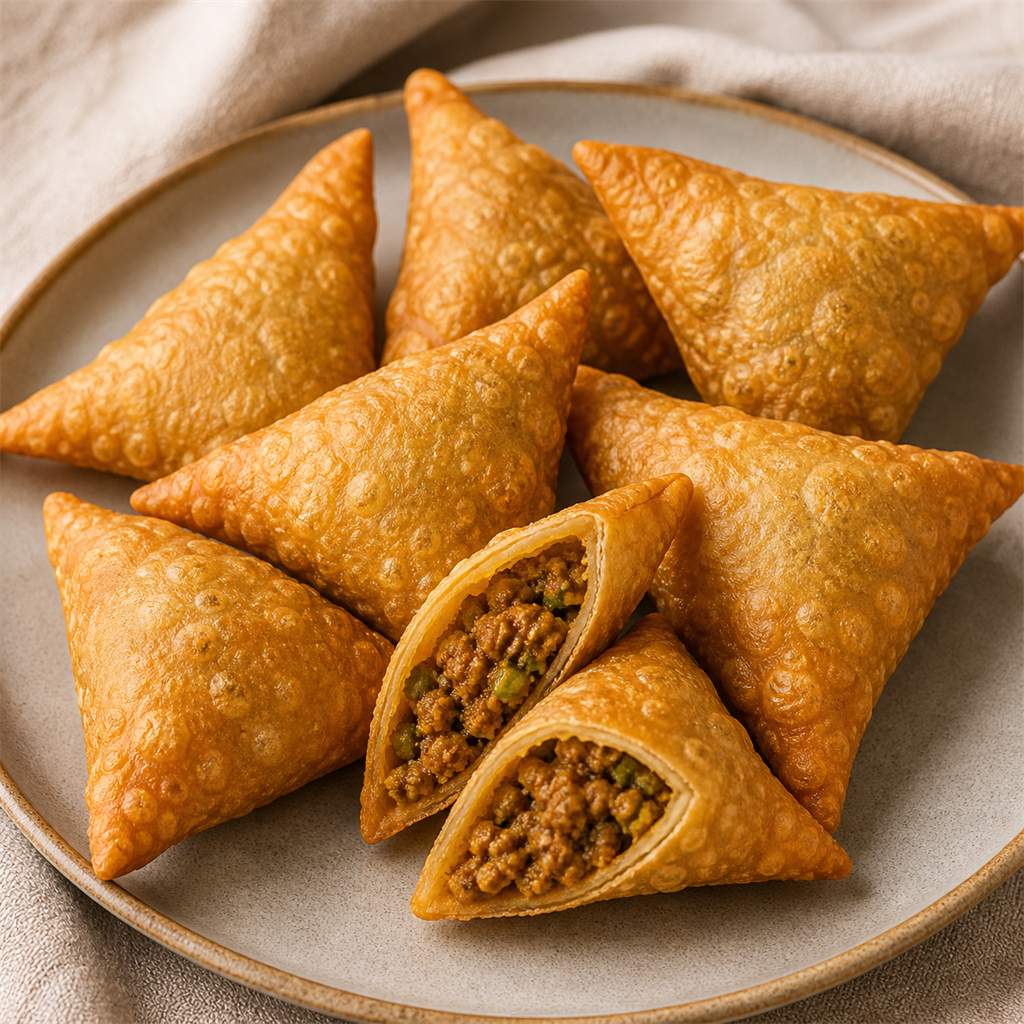
Preparation: 35 min · Cooking: 20 min · Total: 1 hr · 20 servings
Ingredients
- thin samboosa pastry wrappers — 20
- 100 g white onion, finely minced
- 1.5 tsp ground cumin
- vegetable frying oil, about 5 cm depth
- 200 g spring onions, finely chopped and dried
- garlic cloves, minced — 2
- green chillies, finely minced — 2 — Reduce to taste; keep handling tools away from eyes.
- 1 tsp ground coriander
- 1 tsp salt
- 1 tsp ground black pepper
- 1 tbsp wheat flour for sealing slurry
- 1.5 tbsp water for sealing slurry
Instructions
Count pieces and mix sealing slurry
The base yield is 20 individual samboosas, maximum 80 at fourfold, not meal portions. Mix 1 tbsp flour with 1.5 tbsp water for sealing; at fourfold use 4 + 6 tbsp. Frying oil is a separate unmeasured depth allowance.
Frying oil is a separate unmeasured depth allowance.
Wash, dry and chop the vegetables
Rinse spring onions and chillies under running water, dry thoroughly and chop finely with clean tools. Mince white onion and garlic. Washing removes debris but does not sanitize produce. Keep wrappers covered according to their packet and handle flour separately from ready-to-eat foods.
Keep wrappers covered according to their packet and handle flour separately from ready-to-eat foods.
Mix the green filling
Mix 200 g spring onions, 100 g white onion, 2 garlic cloves and the chillies. Add cumin, coriander, salt and black pepper and combine evenly. Divide the entire filling into 20 equal shares, or 80 at fourfold; do not equate one tablespoon with 15 g. Keep the waiting filling refrigerated at 4°C or colder.
Keep the waiting filling refrigerated at 4°C or colder.
Fold and seal without overstuffing
Put one equal share of filling on each suitably sized wrapper. Fold diagonally into a triangle, without overstuffing. Seal the final flap with a small share of the measured flour-water slurry. Keep waiting wrapped pieces cold and do not taste raw pastry or sealing paste.
Keep waiting wrapped pieces cold and do not taste raw pastry or sealing paste.
Fry small batches at 175°C
Heat vegetable oil to about 5 cm depth in a stable deep pot, never more than half full. Monitor 175°C with a suitable thermometer. Fry 4–5 pieces at a time for about 3 minutes, turning with dry tools or a slotted spoon, following wrapper directions. Continue as needed for fully cooked pastry rather than multiplying time with batch size.
Continue as needed for fully cooked pastry rather than multiplying time with batch size.
Fry small batches at 175°C: 180 seconds
Inspect pastry and serve hot
After frying at 175°C, open a test piece carefully away from steam. Filling must be hot throughout and inner pastry layers and flour-sealed seams completely cooked, without raw paste or dough. Continue cooking if needed, then drain with a slotted spoon onto clean paper or a rack. Serve promptly; a golden shell alone is insufficient.
Serve promptly; a golden shell alone is insufficient.
Portion leftovers for quick cooling
Move leftovers into small shallow containers promptly, with clean tools. Refrigerate within 1 hour at 4°C or colder rather than waiting for them to become room-temperature first.
Refrigerate within 1 hour at 4°C or colder rather than waiting for them to become room-temperature first.
Use within two refrigerated days
Promptly divide leftovers into shallow containers and refrigerate within 1 hour at 4°C or colder. Do not wait for a deep pot to cool to room temperature. Use within 2 days. These are conservative owner-selected household limits, not validated shelf life.
These are conservative owner-selected household limits, not validated shelf life.
Tips
- Amounts and divided allowances in the instructions describe the base batch. Scale them with the ingredients, not the timer durations. Use appropriately sized pots or several comparable batches for a larger yield.
Common mistakes
- Do not use a timer, colour or aroma alone as proof of readiness; follow the stated texture and temperature checks.
Substitutions
- This approved version has green onions, not the old beef filling. Choose suitable thin wrappers and check wheat, egg and milk labels; use plant-based wrappers if a vegan version is needed.
Storage
Promptly divide leftovers into shallow containers and refrigerate within 1 hour at 4°C or colder. Do not wait for a deep pot to cool to room temperature. Use within 2 days. These are conservative owner-selected household limits, not validated shelf life.
Reheating
Reheat at most once to 74°C throughout, checking several centres including rice, bread or pastry where present. Reheating does not repair unsafe storage.
About this recipe
This Bahraini Samboosa master encloses green onions, white onion and ground spices in folded pastry. Its yield counts individual pieces, without claiming that all Bahraini households use the same filling.
Editorial approval does not establish independent kitchen testing. Check allergens and follow safe food handling.